Emergency leak online sealing offshore is the repair of a live, pressurised leak on a platform, riser or topside system while production continues — and offshore it is governed less by the sealing technique than by the permit that allows anyone to touch the pipe at all. On a manned installation no land-based team can authorise that work: the Offshore Installation Manager (OIM) holds the decision, and every other approval sits underneath it.
This guide is written for maintenance superintendents, offshore mechanical and process engineers, asset integrity teams and procurement staff responsible for fixed platforms, floating production units, wellhead towers and their associated risers and export lines. It covers where leaks actually occur offshore, which sealing methods remain practical in a congested and classified environment, how mobilisation by helicopter or supply vessel shapes the schedule, and which standards — NORSOK, IMCA and the safety case regime — genuinely control the work.
What Is Emergency Leak Online Sealing Offshore?
Online sealing is the controlled repair of a leak on an in-service pressurised system by fitting an engineered enclosure — a clamp, box, band or bolted housing — around the defect and injecting sealant into the cavity until the leak path is closed. The system stays live throughout: the fluid continues to flow at operating pressure and temperature, and nothing is depressurised or drained. Offshore, the same technique is applied to topside process piping, riser tops, manifold and tie-in spools, flanged joints and sea water or utility systems, but inside a working envelope that is a small fraction of the onshore equivalent.
What changes offshore is not the physics of the enclosure but the perimeter around it. A clamp that would be installed from a scaffold on land is installed from a platform deck with a defined escape route, fixed and portable gas detection above the work site, and a permit that specifies the exact zone, the permitted hours and the maximum injection pressure authorised for that system. The enclosure is ordinary engineering; the permission to install it is not.
Why Offshore Is a Different Discipline From Onshore
The core engineering carries across from any onshore plant: enclosure design, sealant compatibility, injection control, verification. Six environmental factors, however, rewrite the plan before a single fitting is selected.
- No retreat path. On land a leaking hydrocarbon line can be approached, assessed and backed away from at walking pace. On a congested deck the escape route may be a single ladder or stairwell, and a release inside a partially enclosed module can cut the only way out. Escape, muster and temporary refuge arrangements have to be validated before the first tool is unpacked, not after.
- Gas accumulation in confined spaces. Module enclosures, cellars, pump rooms and cofferdams trap heavier-than-air hydrocarbon vapour and hydrogen sulphide. Continuous gas monitoring, pre-entry testing and mechanical ventilation are mandatory preconditions, and the permit is void the moment readings move.
- Weight and access limits. Everything that arrives on the installation arrives by crane, and every crane lift is a planned, risk-assessed operation with a certified load and a certified operator. A 400 kg enclosure assembly that is unremarkable onshore can require a lift plan, a deck study and a weather window offshore.
- Weather windows. Crane operations, vessel approaches, helicopter transfers and even walking on an open deck are all weather-limited. Sea state and wind speed become scheduling constraints on the same level as equipment availability.
- Transport by helicopter or vessel. Crew and urgent small items fly; clamps, injection pumps, gas bottles and generators go by supply vessel or workboat on a sailing schedule that is not negotiable at 03:00. That split determines what can be mobilised in hours and what takes days.
- Strict permitting. Work is executed under a permit-to-work system integrated with the installation’s safety case, with isolation, gas test, simultaneous operations (SIMOPS) and hot work controls applied to every task. The regulatory and documentation burden is materially heavier than onshore.
The practical consequence is that offshore planning is front-loaded. The engineering decision — seal, clamp, wrap or defer — is taken early and in writing, because once a crew is on the installation there is no option to fetch a different fitting from the stores compound.
The Permit-to-Work System and the OIM’s Authority
On an offshore installation, the work permit (izin kerja) and the OIM’s approval are the single determinant of whether a job proceeds. This is not a formality that can be worked around. The OIM is legally and operationally accountable for everything that happens on the installation, and the permit-to-work system is the mechanism through which that accountability is discharged. A vendor, a specialist crew, a service company or even the operator’s own onshore engineering department cannot override it, and a repair plan that assumes otherwise will sit on the deck until it is rewritten.
In practice the sequence runs through several gates, all of which must clear before injection begins:
- Isolation and SIMOPS review. The affected system is identified on the permit, adjacent activities are reviewed for conflict, and any simultaneous operation that could introduce an ignition source or obstruct an escape route is suspended.
- Gas test and area classification. The zone classification of the work site is confirmed, and a gas test is taken at the start of each shift and repeated at defined intervals. Readings are recorded on the permit.
- Risk assessment and method statement. The enclosure installation, injection sequence, maximum injection pressure, hold period and contingency for a worsening leak are documented and accepted by the installation’s operations and safety authority.
- OIM approval. The permit is signed by the OIM or an authorised delegate. This is the point at which the job becomes legal and safe to execute — and the point at which a plan can also be refused outright.
- Change control. Any deviation from the approved method — a higher injection pressure, a different sealant, work outside the permitted zone or hours — requires a fresh permit. Working to an amended plan without re-approval is a stop-work event.
For a contractor mobilised from shore, this has a blunt implication: the technical proposal is a proposal, not a schedule. Crews that understand the permit system plan their offshore days around permit issuance, gas test timings and shift handovers, and build contingency for the possibility that the OIM declines the work on the day.
Where Leaks Occur Offshore and What Can Be Done
Offshore leaks cluster around a predictable set of locations. Each has a practical sealing method, and each carries a constraint that does not exist onshore. The table below is a working decision framework, not a substitute for a site-specific engineering assessment.
| Leak location | Typical sealing method | Offshore-specific constraint |
|---|---|---|
| Topside process piping — main line and small bore | Bolted or hinged clamp with injected sealant; box enclosure on irregular geometry | Congested pipe racks, minimal access, hot surfaces adjacent to the work, permit-limited hours |
| Riser — top section and splash zone | Split clamp or enclosure with high-integrity sealant; composite wrap only where a pressure-relief path exists | No retreat path, wave and current loading, access only from a working platform or rope access team |
| Manifold and flowline tie-in spools | Enclosure around the joint or spool, sealant injection at low controlled pressure | Multiple live headers in close proximity, high consequence of escalation, SIMOPS restrictions |
| Flanged joint — bolted connection | Sealant injection into the flange gap, external bolted band or box, controlled bolt re-tensioning | Limited bolt access, torque tooling weight, corrosion and coating on ageing flanges |
| Sea water and utility systems | Mechanical clamp with elastomeric or composite seal; injection only where chemistry allows | Corrosive and erosive service, high chloride environment, risk of external corrosion under insulation |
| Instrument and small-bore tubing | Compression fitting replacement or mechanical clamp; injection rarely suitable | Very small leak paths, vibration fatigue, difficult to isolate without affecting control loops |

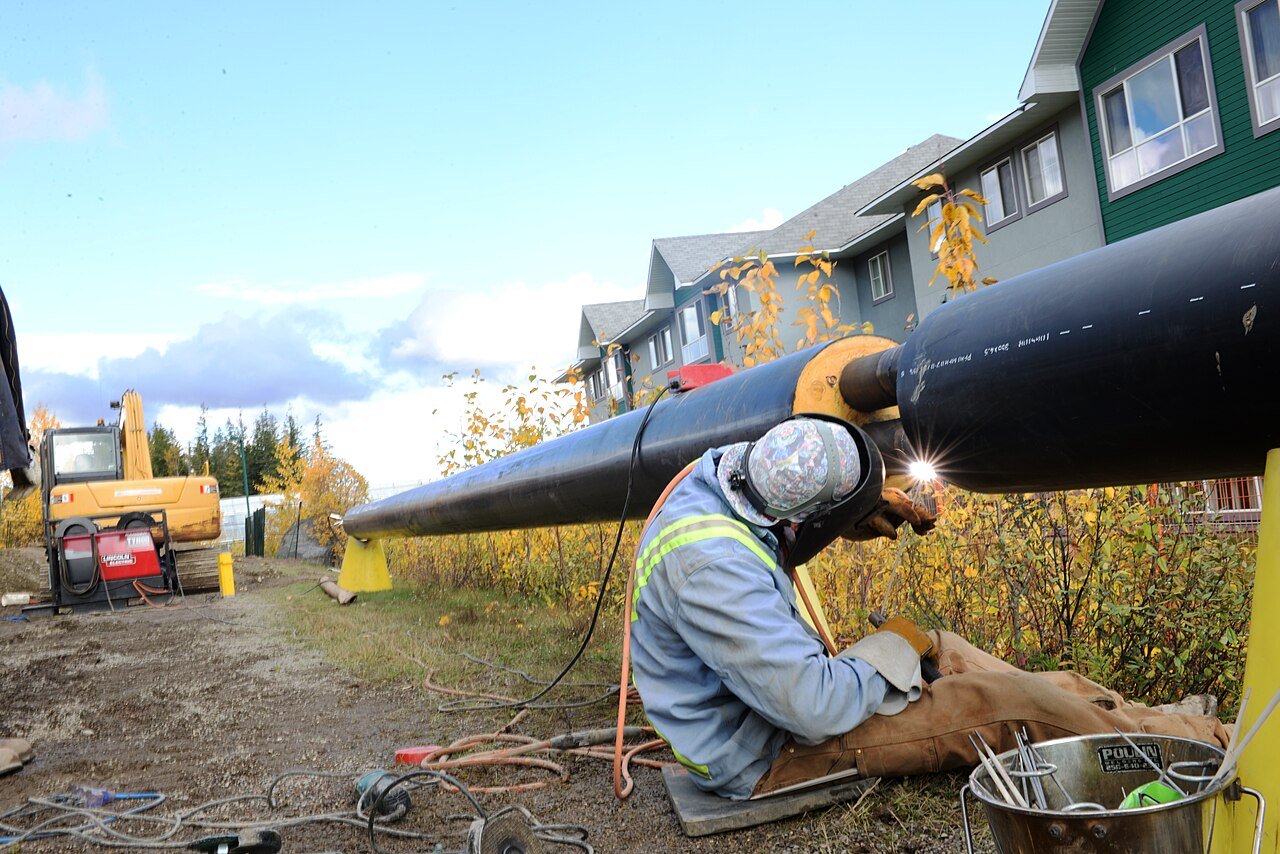
Almost every offshore repair starts at a shore base like this one — clamps, injection pumps, gas bottles and generators travel to the installation by vessel, not with the crew.
Topsides Piping: Working in a Space That Is Already Full
Topside process piping is where most online sealing offshore is performed, and it is also where the environment most sharply limits the work. Pipe racks and module decks are designed for flow, not for maintenance access. A leaking flange may sit at shoulder height in a gap between a hot line and an instrument cable tray, with the only approach from one side and no room to swing a torque wrench.
The practical response is to reduce the size and weight of everything that goes to the work site. Clamps are designed in segments that a single technician can carry through a walkway rather than as one assembly that needs a crane. Injection equipment is specified with hoses long enough to place the pump outside the congested area, so that the operator is not standing inside the module while pressure is applied. Where a box enclosure is unavoidable, it is pre-assembled on the deck and moved as one lift under a lift plan.
Small-bore piping deserves particular attention. Vibration fatigue on instrument and utility small bore is a recurring offshore failure mode, and the leak path is often a hairline crack rather than a joint failure. Sealant injection into a crack of that geometry has limited value; the more defensible repair is usually a mechanical clamp that restores containment and a follow-up engineering review of the support and restraint arrangement, rather than a sealing job that simply hides the symptom. The general method comparison is set out in our guide to emergency leak online sealing, which applies identically in a module and in a refinery unit.
Risers and the No-Retreat-Path Problem
A riser is the pipe that carries production, gas lift, water injection or export flow between the subsea system and the topside. Leaks on risers concentrate at the top section, at flange and weld transitions, and in the splash zone where external corrosion and mechanical loading combine. The consequence of a leak here is disproportionate: the riser may sit directly beside the deck edge, above the sea, with the platform’s accommodation and escape routes in the release path.
The defining constraint is the absence of a retreat path. If a seal fails during injection, the technician is not stepping back to a safe distance on a concrete slab — they are on a small platform, possibly under rope access, with a release blowing into the space they occupy. That reality shapes the method:
- Enclosures are installed and made mechanically secure before any sealant is injected, so that the primary containment exists independently of the sealant.
- Injection is carried out from a position with an unobstructed escape route, using extended hoses rather than working directly over the defect.
- Injection pressure is capped at a value agreed with the process engineer and stated on the permit; exceeding it risks propagating the defect or forcing sealant into the process.
- A worsening-leak contingency is written before work starts, including the trigger for stopping and the action on escalation.
- Wind direction, gas detection coverage and muster arrangements are confirmed for the specific work position, not for the platform in general.

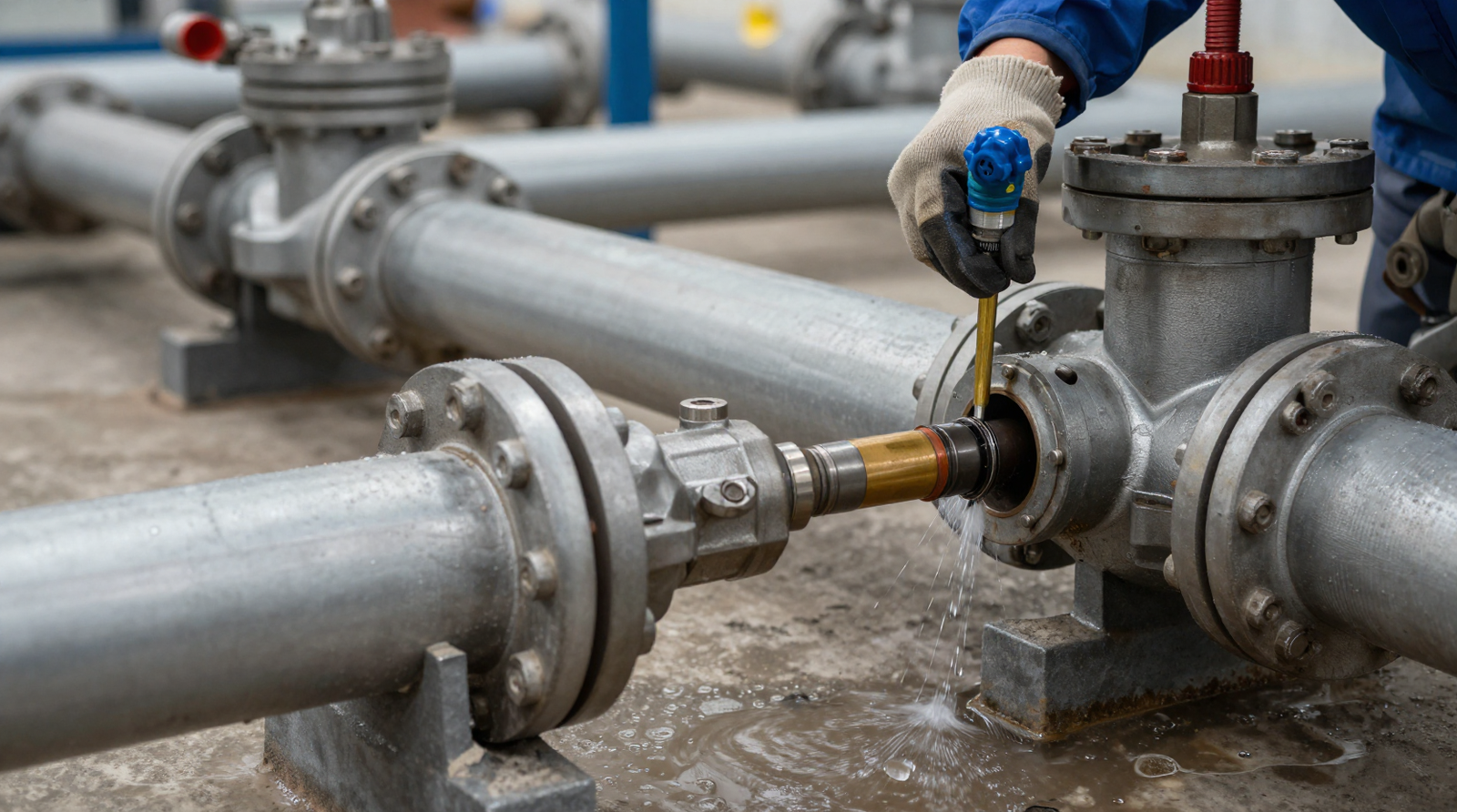
Open deck, open water, and no second exit — the geometry of a platform is the reason riser and deck-edge repairs are planned around escape and muster before they are planned around tooling.
Manifolds, Flanges and Bolted Connections
Manifolds concentrate a large number of flanged joints, valves and small connections into a small area, and they are almost always live. A leak on a manifold flange is rarely isolated, because the header feeds several wells or several consumers and shutting it down may stop production across the installation rather than on one line. That is precisely the situation where online sealing earns its place: the joint is sealed in situ, the header stays in service, and the repair is scheduled for a later intervention window.
Flange leaks offshore have a specific failure profile. Ageing flanges on older installations often carry degraded coatings and external corrosion, so the bolt load is no longer what it was at commissioning. A sealant injected into the flange gap will close the leak, but if the joint has lost bolt preload the seal is a containment measure rather than a restoration of joint integrity. Responsible practice is to combine the seal with a controlled re-tensioning of the bolting, in a defined sequence and to a torque value specified by the engineering authority, and to record both actions. The dedicated method set for bolted joints is described in our guide to flange leak online sealing, and where the valve itself is the leaking component, the approach is covered under valve online leak sealing.
Where a manifold is under high pressure and the leak is at the body or bonnet rather than the flange, the enclosure has to be designed for the specific pressure rating rather than adapted from a standard clamp. That engineering demand is the same one addressed in our material on high pressure leak sealing solution, and offshore it is compounded by the need to keep the assembly light enough to handle on a congested deck.
Sea Water and Utility Systems
Sea water systems — cooling, firewater, injection and utility duties — are the second most common offshore leak source after hydrocarbon piping, and they are frequently underestimated. The fluid is not flammable, but the service is aggressive: chlorides, dissolved oxygen, biological activity and suspended solids combine with high flow velocities to produce erosion-corrosion, pitting and under-deposit attack. Leaks appear at bends, at reducer and tee transitions, at flanged joints, and at the interface between the pipe and its support.
Two factors make sea water leaks harder than their hazard classification suggests. First, the leak is often a wall-thinning defect rather than a joint failure, which means the repair has to address remaining wall thickness, not just close an opening. A clamp over a thinned bend relocates the failure to the edge of the clamp; the enclosure must span enough sound metal on both sides to be meaningful. Second, corrosion under insulation hides the condition of the pipe until the leak is already through the wall, so the first visible sign is often a wet patch on the deck rather than a monitored trend.
Sealing on sea water service is therefore usually mechanical: a clamp with an elastomeric or composite sealing element, correctly sized for the outside diameter and the local geometry, with the injection route used only where the sealant chemistry is compatible with the fluid and the temperature. Firewater systems carry an additional constraint — a repair that reduces flow capacity on a fire main is a safety-case issue, and the OIM will normally require an alternative firefighting provision to be in place before the permit is issued.

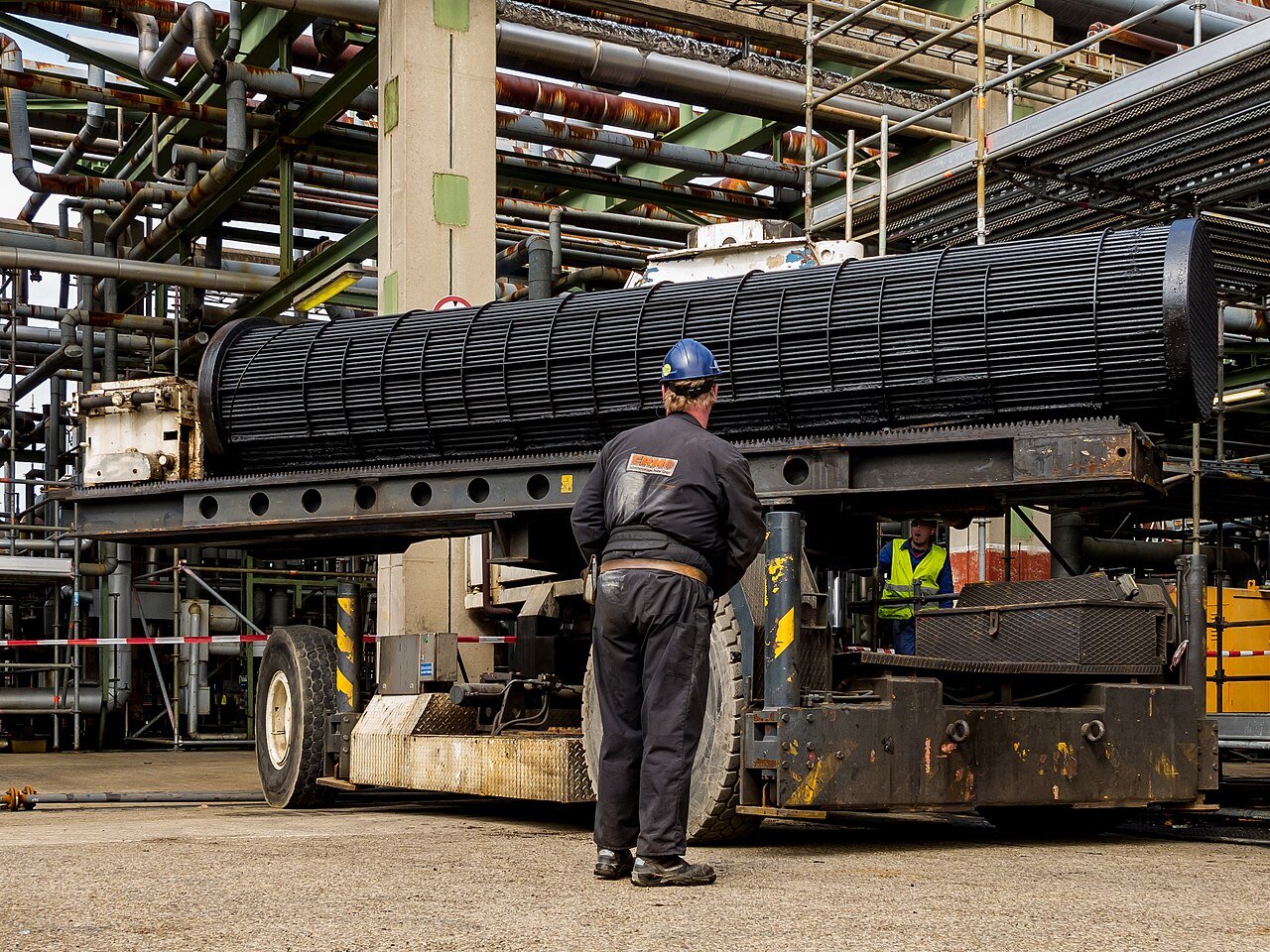
Topside modules pack process piping, manifolds and utility systems into a fraction of the space an equivalent onshore unit would occupy — which is why offshore repairs are designed around handling weight and escape routes.
Mobilisation: Helicopter, Vessel and the Weather Window
Getting to the installation is a scheduling problem that dominates the elapsed time of an offshore repair, in the same way that road and river access dominates a remote onshore job. Two transport modes exist, and the split between them is decided by weight and by urgency, not by preference.
- Helicopter. Carries personnel and small, urgent items. Payload is tightly limited, dangerous goods restrictions apply to sealant and pressurised containers, and flights are weather- and daylight-dependent at many installations. A crew can arrive in hours; a clamp cannot.
- Supply vessel or workboat. Carries clamps, injection pumps, gas bottles, generators, lifting gear and fabricated enclosures. Governed by sailing schedules, berth availability at the shore base, and sea state for the approach and transfer. Realistic lead times are measured in days.
The consequence is a two-stream mobilisation: fly the assessment team and the small tooling, and ship the heavy kit on the next available vessel. For critical systems, the sensible preparation is to hold a limited offshore sealing kit — standard clamps for the installation’s common line sizes and flange ratings, injection equipment, calibrated gauges and gas detection — on board, so that the first hours are spent assessing rather than waiting. The full inventory a competent crew should carry, whether staged ashore or on the platform, is set out in our guide to online leak sealing equipment and tools.
Weather is the other half of the equation. Crane operations for heavy lifts, vessel approaches, helicopter transfers and open-deck work all have defined limits, and those limits are set by the installation, not by the contractor. A planned repair that depends on a lift in a sea state the platform will not authorise is not a plan; it is a hope. Build the schedule around the statistically available window rather than the best case.
Standards and Regulatory Context
Offshore work sits inside a denser standards framework than an equivalent onshore job. Three reference points matter most in the Indonesian and wider South East Asian context.
NORSOK. The Norwegian petroleum industry standards, published under the NORSOK framework, are widely referenced for offshore safety, working environment and technical integrity requirements, and many international operators apply them as good practice well beyond Norwegian waters. They set expectations for risk assessment, escape and evacuation provision, and the management of work in hazardous areas that map directly onto how a sealing job is permitted and executed.
IMCA. The International Marine Contractors Association publishes guidance covering the marine and diving contractor side of offshore work, including competence expectations for personnel working offshore and the conduct of subsea and near-surface operations. Where a riser repair or a splash-zone inspection involves diving or remotely operated vehicle support, IMCA guidance is the normal reference for the competence and safety management of that element.
Safety case and permit regime. In the UK sector, the safety case regime administered by the Health and Safety Executive is the model many operators and regulators follow: the installation must demonstrate that major accident hazards are identified and controlled, and every permit is issued within that framework. In Indonesia, offshore oil and gas activity is supervised through SKK Migas and the Ministry of Energy and Mineral Resources for the upstream side, with the operator’s own safety management system governing day-to-day work on the installation.
On the engineering side, enclosure design, clamp calculations and composite repairs trace to ASME B31.3 Process Piping and ASME PCC-2, with composite repair work following ISO 24817 principles. Material selection for sour service follows NACE MR0175 / ISO 15156. The International Association of Oil and Gas Producers also publishes management guidance on process safety and permit-to-work that underpins most operators’ frameworks. None of these replace the OIM’s decision; they define the technical envelope within which that decision is made.
Hot Work Permits in Hazardous Zones
Online sealing is normally a cold work activity, and that is one of its advantages offshore: it avoids the ignition risk of welding and the consequential requirement for gas-freeing and fire watch that a welded repair would trigger. The advantage is real but conditional, because several sealing activities do involve hot work and are treated accordingly.
- Grinding and cutting. Removing coating, dressing a weld cap or cutting a clamp component on site is hot work and requires a hot work permit, a gas test, firefighting provision and a fire watch for a defined period after the work stops.
- Bolting and torqueing. Normally classified as cold work, but impact wrenches and hydraulic torque tools may be restricted in certain zones, and sparking from a steel-on-steel contact is a recognised hazard in a classified area.
- Injection under pressure. Not hot work, but a pressure activity that requires the maximum injection pressure on the permit and a defined exclusion zone around the equipment.
- Adjacent simultaneous operations. Hot work elsewhere on the installation can suspend a sealing permit, or force a gas test to be repeated, because the ignition source and the hydrocarbon release potential are both present at once.
The practical rule is that a sealing crew should be able to complete the job without any hot work wherever the geometry permits. Where it does not — a seized bolt that must be cut, or a corroded band that has to be removed — the schedule must absorb the permit time, and the plan must state clearly which steps are cold work and which require a hot work permit in a hazardous zone. Where a leak is severe enough that containment is failing faster than a cold-work solution can be applied, the escalation path is generally a controlled depressurisation and shutdown rather than an accelerated welding operation in a live hydrocarbon area.
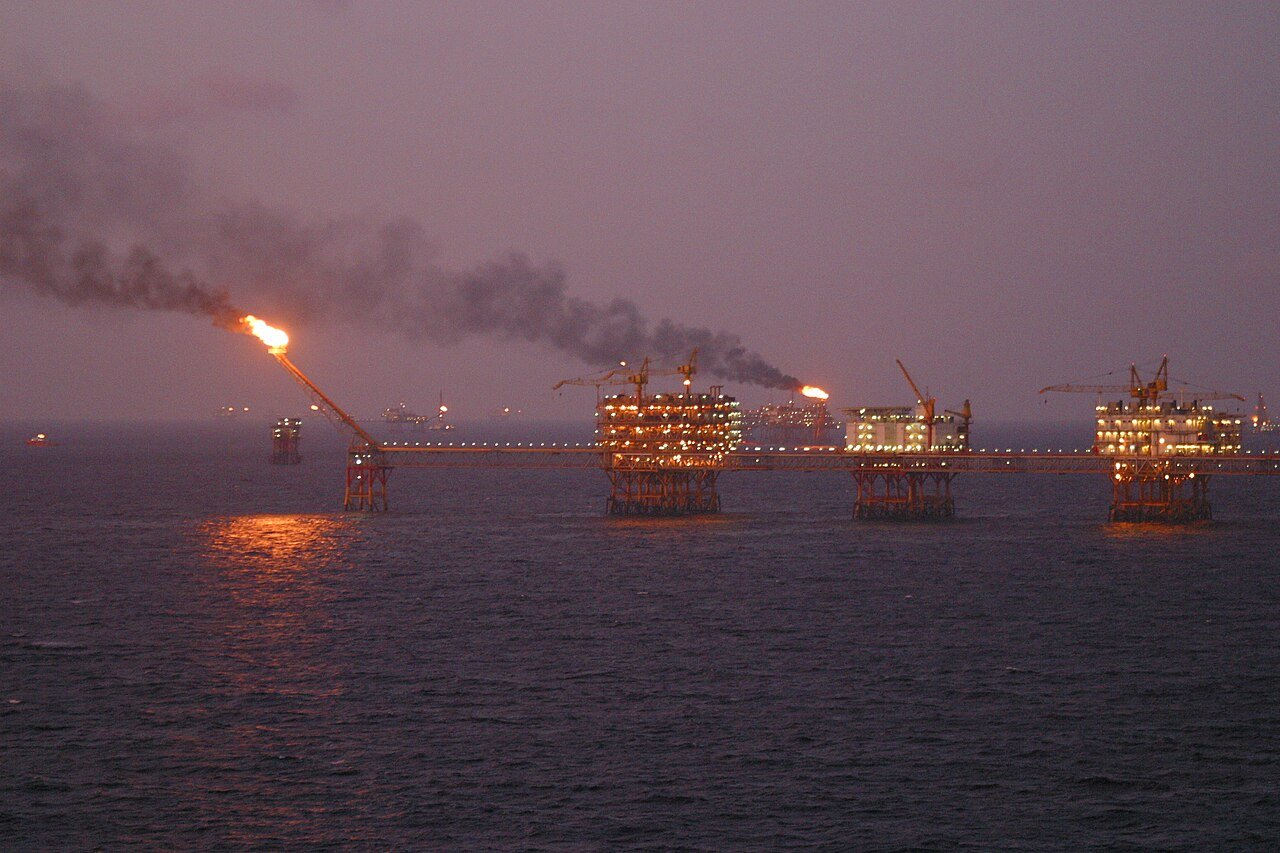
South East Asian installations share the same fundamentals as North Sea platforms — congested topsides, live risers and permit-controlled work — even where the applicable regulator and safety case framework differ.
Documentation and Verification Offshore
Offshore repairs carry a heavier documentation load than onshore work, and for a straightforward reason: reinspection is expensive and, in some cases, impossible without another vessel or helicopter visit. The repair record is the primary evidence that the containment is sound and that the engineering limits were respected.
A defensible offshore sealing package normally contains the permit and gas test records, the enclosure drawing or reference with the design pressure stated, the sealant type and batch number with its data sheet and service temperature rating, the injection pressure log including the agreed maximum, the hold period and verification results, photographic evidence before and after, and an entry in the piping line history with a scheduled wall thickness survey at the repaired location. The verification itself should include a detector check, a visual inspection of the enclosure after the hold period, and confirmation that no sealant has entered the process stream.
Where the repair is intended to remain in place beyond the current production period, it should be recorded as a temporary containment in the asset integrity register and flagged for review at the next planned intervention or turn-around. Treating an offshore seal as a permanent repair without engineering sign-off is how a contained defect becomes an unmonitored one.
Key Takeaways
- Offshore, the sealing technique is rarely the constraint — the permit and the OIM’s approval are, and no onshore team can substitute for them.
- Space, gas accumulation and the absence of a retreat path determine method selection more than pressure or temperature do.
- Design clamps and enclosures to be carried and installed by hand through congested modules; reserve crane lifts for pre-assembled boxes with an approved lift plan.
- Riser and deck-edge repairs must have primary containment installed and secured before any sealant is injected.
- Treat flange leaks as a joint integrity problem: seal the gap and restore bolt preload in a controlled sequence, then record both.
- Sea water leaks are usually wall-thinning defects, so the enclosure must span sound metal on both sides of the defect.
- Split mobilisation between helicopter (people and small tooling) and vessel (clamps, pumps and gas bottles), and build the schedule around the available weather window.
FAQ: Emergency Leak Online Sealing Offshore
Can a leak be sealed on a platform without shutting down production?
Yes, in many cases. Online sealing is designed to close a leak on a live, pressurised system by fitting an enclosure and injecting sealant, with the fluid still flowing. The limiting factors are not the technique but the permit, the availability of an approved enclosure design, and whether the defect geometry allows a mechanically secure installation. Where containment is failing rapidly, shutdown is the correct answer.
Who authorises emergency leak repair work on an offshore installation?
The Offshore Installation Manager holds the decision. The work is executed under a permit-to-work system in which isolation, gas testing, risk assessment and simultaneous operations are reviewed before the permit is signed. A vendor, contractor or the operator’s onshore engineering team can propose and prepare a repair, but none of them can authorise work on the installation. The OIM can also refuse it.
How long does it take to mobilise a sealing crew offshore?
Crews and small tooling can reach an installation by helicopter within hours of call-out, subject to flight availability and weather. Clamps, injection pumps, gas bottles and generators travel by supply vessel and typically take days, depending on sailing schedules and sea state. Holding a limited sealing kit on board removes the largest delay for the most common line sizes and flange ratings.
Is hot work required for online leak sealing offshore?
Usually not. Enclosure installation and sealant injection are cold work, which is a significant advantage in a hazardous zone. However, grinding, cutting or removing a seized component on site is hot work and requires a hot work permit, gas testing, firefighting provision and a fire watch. The repair plan should state clearly which steps fall into each category.
What standards apply to offshore leak sealing and clamp design?
Enclosure and clamp calculations trace to ASME B31.3 and ASME PCC-2, composite repairs follow ISO 24817 principles, and sour service material selection follows NACE MR0175 / ISO 15156. Offshore safety and working environment expectations are commonly drawn from the NORSOK framework, marine and diving support from IMCA guidance, and the whole activity sits inside the installation’s safety case and permit system.
Leak still running and the plant is on limited time? Our response desk is staffed around the clock. Message the emergency team on WhatsApp or send a site brief with the line ID, medium, operating pressure and temperature, and we will confirm scope before mobilisation.
Conclusion
Emergency leak online sealing offshore is the same engineering as onshore work, executed under a fundamentally different set of controls. The enclosure is still a designed pressure-containing component, the sealant still has to be compatible with the fluid and the temperature, and the injection pressure still has to be agreed and respected. What changes is that the working space is congested and classified, the escape route may be the only way out, the heavy equipment arrives on a vessel schedule, and the authority to begin sits with the OIM rather than with anyone on shore.
For operators of platforms, floating production units and wellhead towers in Indonesian waters and across the region, the useful preparation is not a faster reaction but a better-formed one: pre-agreed enclosure designs for the installation’s critical flanges and piping, a limited sealing kit held on board, a clear split between what flies and what sails, and a documented understanding that the permit governs the schedule. Where a riser, manifold or sea water system is involved, the additional step is a review of containment strategy against the asset integrity register, so that a temporary seal is recorded as temporary. Our team supports both the engineering and the offshore execution, and the service overview at our leak sealing services sets out how a live leak repair offshore is scoped, permitted and delivered. Where the affected line is a subsea export route rather than a topside system, the planning context is covered in our guide to subsea pipeline decommissioning in Indonesia, and for installations in the Indonesian archipelago the regional model described in our emergency leak online sealing Kalimantan article shows how shore bases and vessel logistics are organised around the same constraints.