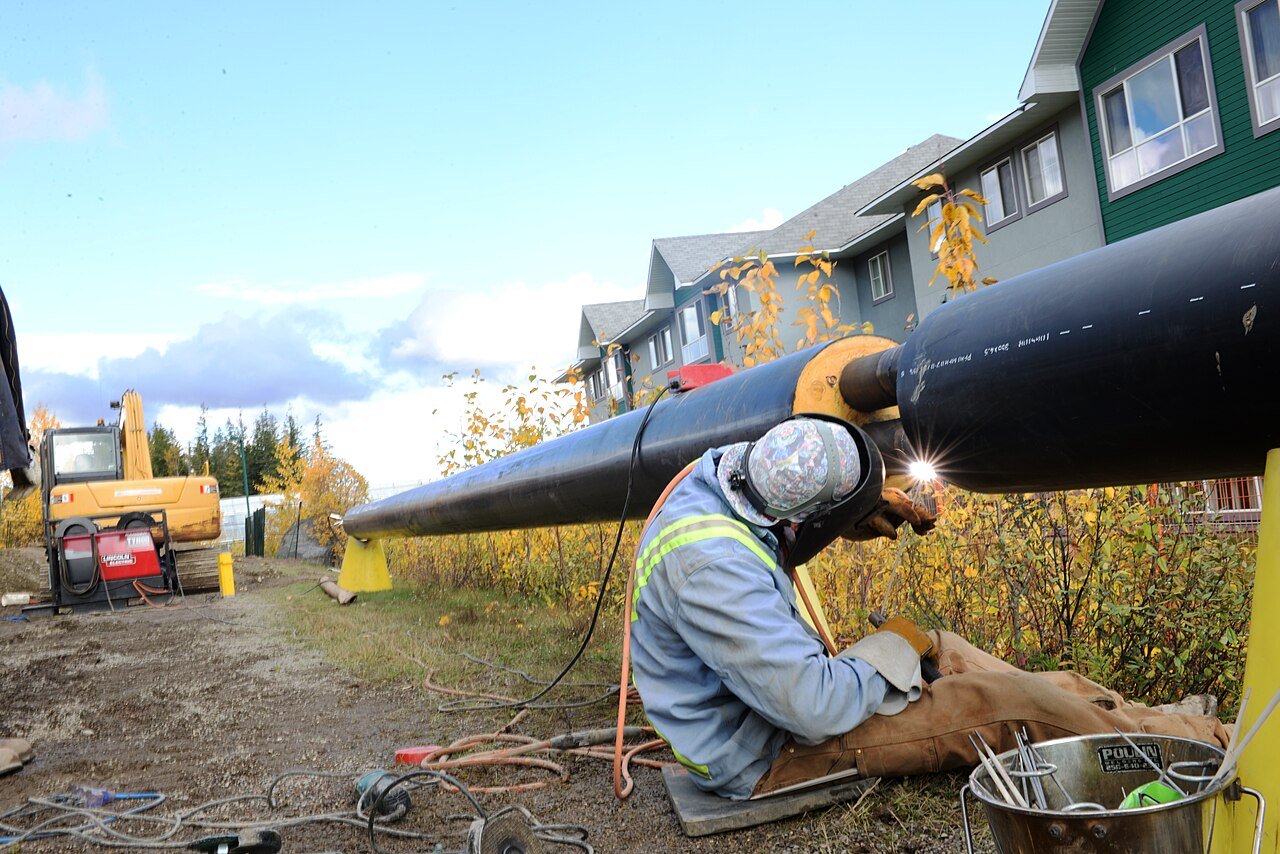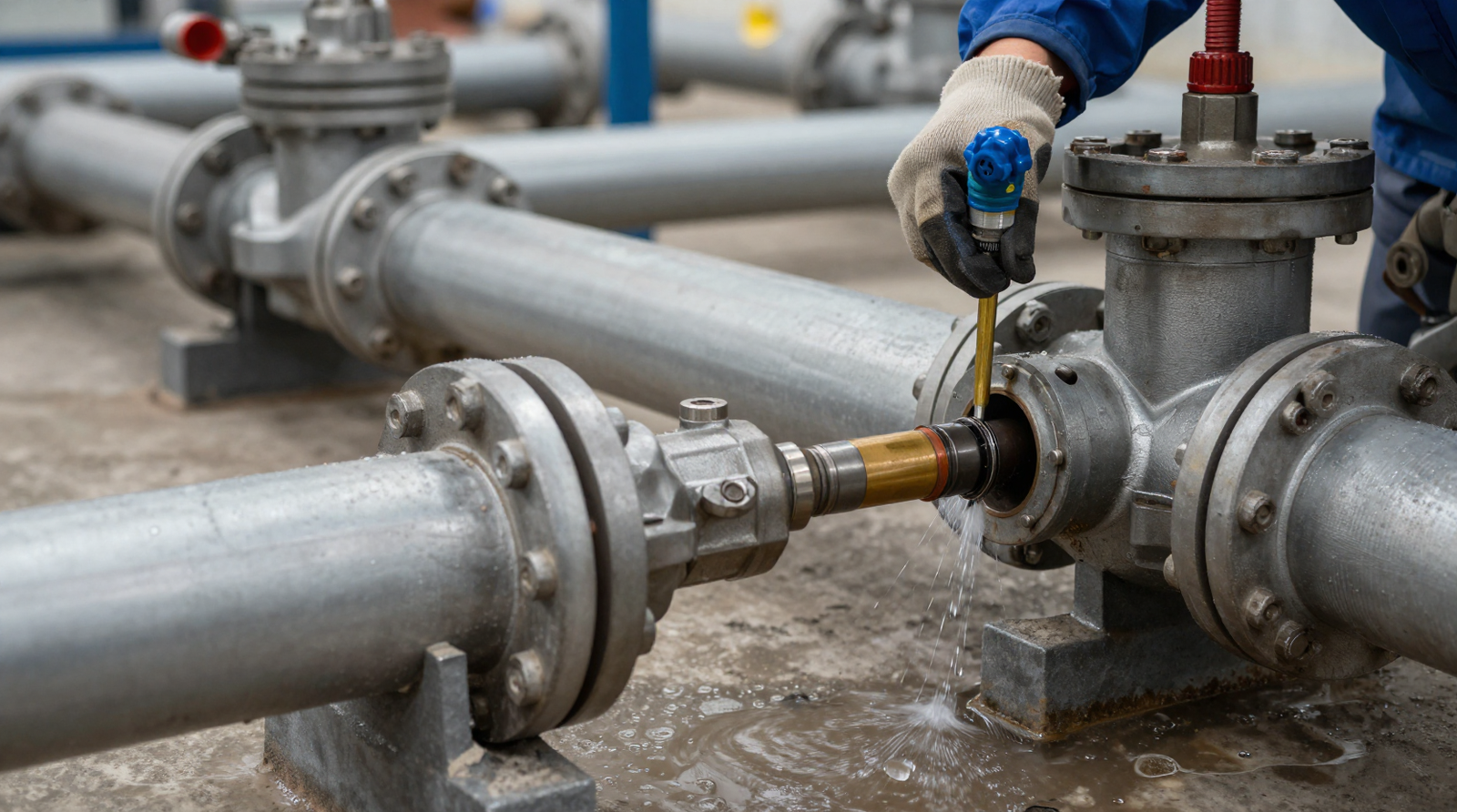
Choosing between composite repair wrap vs online leak sealing comes down to what the defect actually is: composite wrap restores lost wall strength on a thinned pipe, while online leak sealing stops an active escape of process fluid at a joint, valve or irregular surface.
This comparison is written for maintenance engineers, reliability leads, process authorities and procurement teams in Indonesian refineries, petrochemical plants, gas processing facilities and power stations who must select a repair method and defend that choice on the record. It sets out what each method can and cannot do, how the two differ against the criteria that actually decide an outcome, when they should be combined in sequence, and the one failure mode that has destroyed wraps and injured crews — trapping pressure under a composite that was never given a relief path.
What Is Composite Repair Wrap?
Composite repair wrap is a permanent or long-term restoration of pipe wall strength using a resin-saturated fibre laminate bonded to the external surface of the pipe, designed in accordance with ISO 24817 or ASME PCC-2 Article 4.3. The wrap is engineered as structural reinforcement: the laminate carries the hoop and axial loads that the corroded wall can no longer support, and the design is qualified by calculation rather than by judgement on site.
Under ISO 24817, the repair design must account for defect geometry, remaining wall thickness, design pressure and temperature, and the service life required. ASME PCC-2 gives the equivalent method for non-metallic composite repairs to pressure equipment. Both frameworks require a qualified procedure, a written design calculation, trained applicators and surface preparation to a defined standard. Composite wrap is therefore a controlled engineering activity, not a wrapping exercise.
What it does well: it restores structural capacity on straight pipe, elbows and long runs where wall loss is distributed, and it can hold back minor weeping or seepage once that seepage has been stabilised. What it does not do: it cannot be applied over a live jet, it cannot conform reliably to a badly irregular or wet surface, and it cannot substitute for a pressure-containing seal on a joint that is actively leaking.
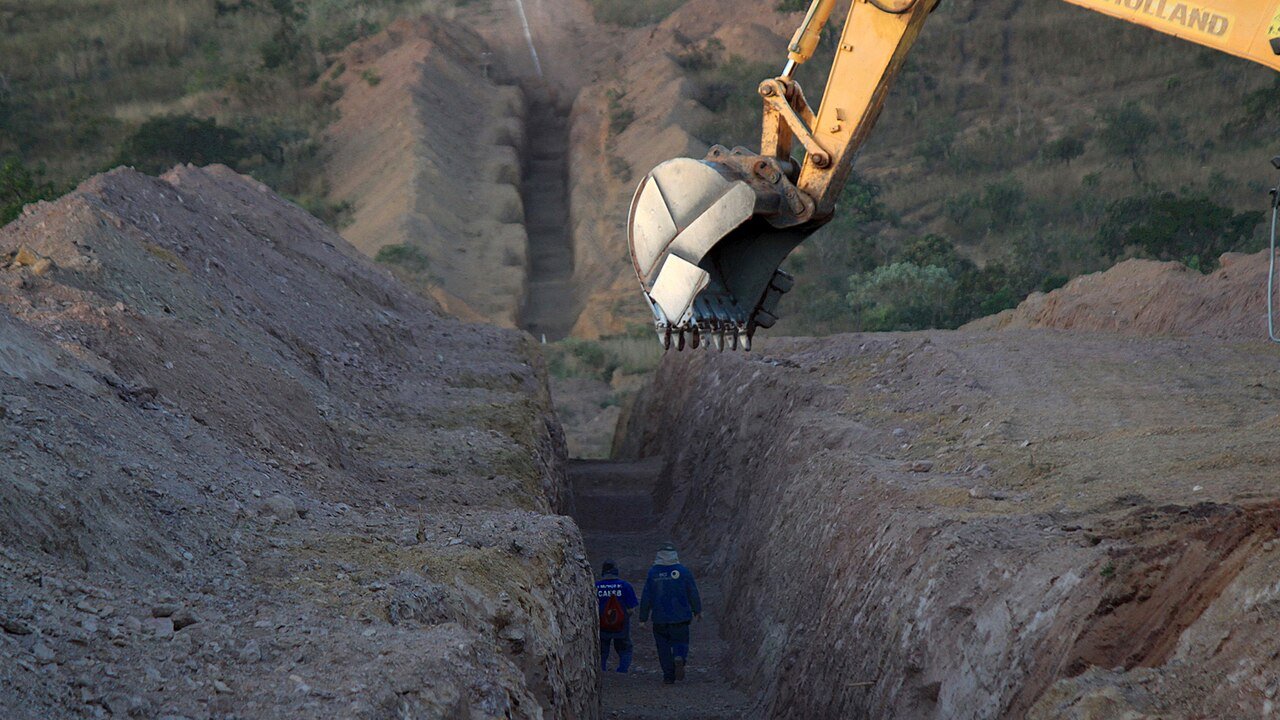
Composite wrap is engineered against remaining wall thickness and design conditions on a defined pipe run. On buried or long-run pipe, that design basis — not the wrap material alone — determines whether the repair is acceptable under ISO 24817.
What Is Online Leak Sealing?
Online leak sealing stops an active leak on a pressurised system while that system stays in service. A fabricated enclosure, box, clamp or band is fitted over the leaking point and a sealant is injected through it, forcing a sealing compound into the leak path against the process pressure. The enclosure and the injected sealant together become a new pressure boundary, and the plant keeps running.
The method suits exactly the geometry that composite wrap struggles with: bolted flanges, valve glands and bonnets, threaded connections, welded joints and irregular or pitted surfaces. It also suits the case where fluid is escaping now and cannot wait for a surface to be cleaned and dried. Under ASME PCC-2 and API practice, the injection pressure must be agreed in writing with the process authority, and the sealant must be compatible with the fluid, the temperature and the pressure it will see.
What it does well: it arrests an active leak quickly, often within hours of mobilisation, and it works on shapes that no laminate can conform to. What it does not do: it generally does not restore structural wall strength, so it should not be treated as a substitute for a wall-loss repair where the pipe has lost metal. It stops the leak; it does not necessarily rebuild the pipe.
How the Two Methods Differ at the Engineering Level
The distinction is not good method versus bad method — it is different problem, different physics. Composite wrap is a structural design problem: how much load must the laminate carry, and for how long? Online leak sealing is a pressure-containment problem: how do you create a seal at a point where fluid is already escaping?
That difference drives everything else. It drives what each method needs on site — a clean, dry, prepared surface for wrap, versus an accessible leak point and an injection path for sealing. It drives the time profile — wrap needs cure time, sealing needs stabilisation time. And it drives the inspection burden — wrap needs a design record and a qualified procedure, sealing needs an injection pressure record and a compatibility basis.
It also drives the failure mode. A wrap that fails has usually been applied to the wrong surface or over a live leak. A seal that fails has usually been applied outside its temperature, pressure or chemical envelope. Understanding which failure you are exposed to is the first step in choosing correctly.
Side-by-Side Comparison: Decision Criteria
The table below compares the two methods against the criteria that decide most field decisions. The final column states the case in which each method is usually the stronger choice.
| Criterion | Composite repair wrap | Online leak sealing | Usually the stronger choice when |
|---|---|---|---|
| Nature of the leak | Minor seepage or weeping, often with no visible flow | Active leak, jet, drip or continuous escape | Sealing for active leaks; wrap for seepage after it has been stabilised |
| Pressure and temperature | Bounded by laminate and adhesive service limits, often with lower temperature ceilings | Bounded by sealant and enclosure rating, and can be specified for higher temperatures | Wrap on moderate service; sealing where a hot or higher-pressure leak must be contained now |
| Surface condition | Requires a clean, dry, prepared surface to a defined standard | Tolerates wet, oily and irregular surfaces | Sealing on unprepared or contaminated geometry |
| Restores structural strength? | Yes — that is its purpose; it carries hoop and axial load by design | Generally no — it contains pressure, it does not rebuild wall | Wrap where wall loss is the defect |
| Cure or setting time | Cure time required before full service load, typically hours depending on resin and temperature | Sealant sets as it is injected; containment is immediate once injection holds | Sealing when the plant cannot wait for cure |
| Supervision and records | Qualified procedure, design calculation, applicator competency | Injection pressure agreement, sealant compatibility record, process authority sign-off | Both — neither should proceed without documented controls |
| Typical geometry | Straight pipe, elbows and long runs with distributed wall loss | Flanges, valve glands and bonnets, threads and irregular surfaces | Match the method to the geometry in front of you |
Read the table as a decision aid, not a ranking. A flange dripping hydrocarbon is a sealing problem, and no laminate will solve it. A long run of pipe with thirty per cent wall loss but no active leak is a wrap problem, and no enclosure will restore the metal.
When Composite Repair Wrap Is the Right Choice
- Wall loss is the defect. General or localised corrosion has reduced wall thickness and the pipe needs its structural capacity back.
- There is no active leak, or only minor weeping. The surface can be prepared, cleaned and dried to the standard the laminate requires.
- The geometry is regular. Straight pipe, elbows and long runs that a laminate can conform to without bridging.
- A defined service life is needed. The repair must be designed and recorded against design pressure, temperature and remaining life.
- The defect is within a qualified envelope. Defect size, remaining wall and design conditions all fall inside the validated limits of the procedure.
- Cure time is available. The line can tolerate the period before the laminate reaches full service capability.
When Online Leak Sealing Is the Right Choice
- Fluid is escaping now. The leak is active and the plant cannot be shut down to deal with it.
- The leak is at a joint or fitting. Flanges, valve glands, bonnets, threaded connections and welded joints are the method’s natural territory.
- The surface is irregular or contaminated. The geometry will not accept a bonded laminate but will accept an enclosure and injection.
- Wall strength is intact. The pipe has not lost metal; the problem is containment, not structure.
- Speed matters more than permanence. The immediate priority is to stop the escape and stabilise the system.
- The leak can be reached. There is access to fit an enclosure and inject sealant safely, with a defined injection pressure.
Related method detail is covered in the online leak sealing technology and methods overview, and the joint-specific case is described in valve online leak sealing.
When to Use Both Methods Together
The two methods are not competitors in every case. On a corroded run that has begun to weep, the correct sequence is often seal first, wrap second: stabilise the escape, then restore the wall.
- Assess the defect. Measure remaining wall thickness, confirm the leak rate, and record the operating pressure and temperature.
- Stabilise the leak. If fluid is escaping, seal it with an enclosure and a compatible sealant so the surface can be worked on.
- Prepare the surface. With the leak controlled, clean, dry and profile the pipe to the standard the laminate procedure requires.
- Apply the composite wrap. Install the laminate to the qualified design, carrying the loads the corroded wall can no longer support.
- Allow cure and record. Let the laminate reach service capability, then document the design, the materials and the outcome.
This sequence resolves the conflict between the two methods’ requirements: sealing removes the flowing fluid that would prevent a bond, and the wrap then restores the structural capacity that the seal alone cannot provide.

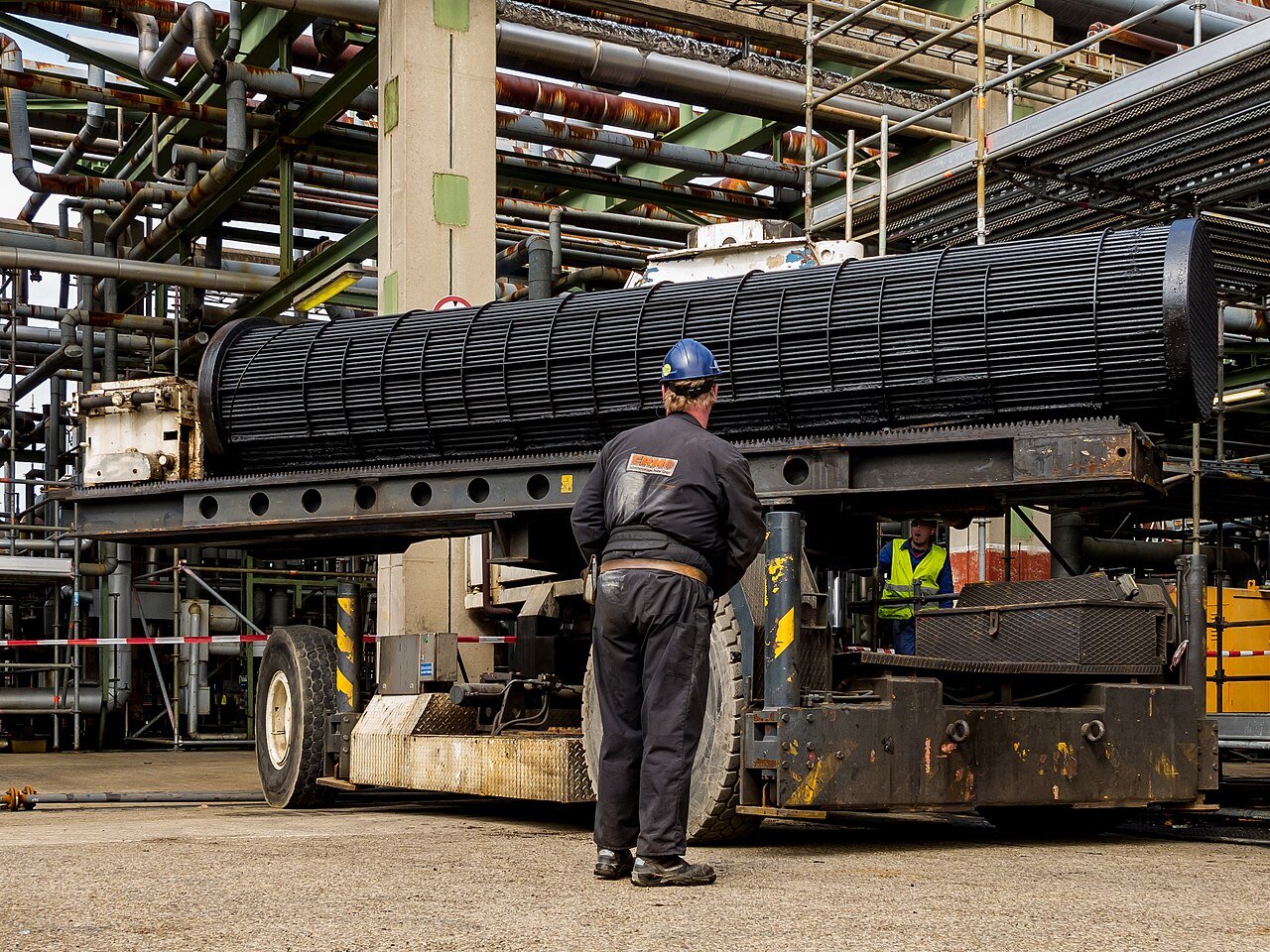
On refinery pipework the two methods are frequently sequenced rather than chosen. A sealed leak that is left without a wall repair remains a structural defect, and a wrap applied over an unstabilised leak is a pressure trap.
The Danger of Wrapping an Active Leak
Do not install a composite wrap over an active leak unless there is a confirmed pressure-relief path or the leak has been properly sealed and stabilised first. This is the single most important safety point in the comparison.
A composite wrap is bonded to the outside of the pipe and cured. If fluid continues to escape underneath it, pressure accumulates in the gap between the pipe wall and the laminate. That space becomes a pressurised cavity bounded by the laminate. As pressure builds, the laminate can blister, delaminate or rupture, releasing stored energy and whatever process fluid is trapped inside.
The consequences are worse than the original leak. The wrap may fail suddenly, at the moment of maximum cure strength, sending fragments and a pressurised fluid release toward anyone nearby. The pressure that was previously escaping as a manageable drip or jet is now contained until the laminate gives way all at once.
Two controls prevent this. First, if a leak is active, seal it — with an enclosure and injection — so that no fluid flows under the laminate. Second, if any weep is expected, design in a controlled relief path or vent so pressure cannot build behind the wrap. According to ASME PCC-2, the repair design must account for the service conditions the laminate will actually see; a wrap that is quietly trapping pressure has not been designed for the conditions it is in. The same discipline applies on the sealing side, which the sealant selection guide covers in detail.
Standards and Qualification Requirements
Both methods carry a standards basis, and a competent contractor should be able to state it before work starts.
- Composite wrap: designed to ISO 24817 or ASME PCC-2 Article 4.3, with a written design calculation and a qualified application procedure.
- Pressure boundary design: enclosure and clamp design aligned with ASME PCC-2, with thickness and rating derived rather than assumed.
- Corrosion assessment: remaining wall and defect evaluation consistent with API in-service inspection practice.
- Materials engineering: laminate, adhesive and sealant qualification informed by guidance from bodies such as AMPP and TWI.
- Records: design calculations, material certificates, injection pressure logs and applicator competency for both methods.
Cost and Downtime Profile
Neither method should be selected on purchase price alone, because the dominant cost in either case is the consequence of getting it wrong. Even so, the cost structures differ in shape.
Composite wrap carries engineering cost up front — design calculation, qualified procedure and prepared surface — but the material itself is comparatively modest and the work is planned. Online leak sealing carries an emergency premium: rapid mobilisation, out-of-hours crew, and the engineering judgement to contain a live leak safely. That premium reflects urgency and risk, not simply labour. Where a leak halts production, the avoided downtime usually dominates every other line in the comparison, which is why the cost and downtime reduction analysis matters more than a rate comparison.
The practical rule: cost composite wrap as a planned engineering repair, cost online leak sealing as an emergency intervention, and compare both against the cost of the shutdown that neither method requires. For a broader view of how live repairs are executed, the emergency leak online repair solution guide and the emergency leak online sealing page describe the delivery model behind both.

Online leak sealing is typically mobilised out of hours, which shapes its cost profile. Composite wrap, by contrast, is usually planned work with the design calculation completed before the crew arrives.
Key Takeaways
- Composite repair wrap restores structural wall strength to ISO 24817 or ASME PCC-2; online leak sealing contains an active leak with an enclosure and injected sealant.
- Match the method to the defect: wall loss and seepage suit wrap; active leaks at flanges, valves and irregular surfaces suit sealing.
- Sealing generally does not rebuild wall, and a wrap cannot conform to a wet, irregular or actively flowing surface.
- Sequence matters on a weeping corroded line: stabilise the leak first, then apply the composite wrap to restore strength.
- Never wrap over an active leak without a confirmed relief path or a properly stabilised seal — trapped pressure can rupture the laminate.
- Both methods require documented controls: a design calculation for wrap, an agreed injection pressure and sealant compatibility record for sealing.
- Compare total cost, not rate cards: avoided shutdown usually outweighs the difference between planned and emergency pricing.
FAQ: Composite Repair Wrap vs Online Leak Sealing
Is composite repair wrap a permanent repair?
It can be. Under ISO 24817 and ASME PCC-2, a composite wrap is designed for a stated service life against defined pressure, temperature and defect conditions. Within that qualified envelope, and with a correct surface preparation and cure, it is treated as a permanent repair rather than a temporary patch. Outside that envelope — or applied over a live leak — it is neither permanent nor safe.
Can online leak sealing be used on a corroded pipe with wall loss?
Yes, to stop the leak, but understand what it does not do. Sealing contains the escaping fluid; it does not restore the metal that corrosion has removed. Where wall loss is significant, sealing may be a first step to stabilise the system, but the structural defect still needs assessment and, usually, a composite wrap or a pipe replacement. Sealing alone should not be recorded as a wall-loss repair.
Can the two methods be used together on the same defect?
Yes, and on weeping corroded pipework this is often the correct answer. Seal the active leak first with an enclosure and compatible sealant, so the surface can be cleaned and dried. Then apply the composite wrap to the qualified design to restore structural capacity. The sequence resolves the conflict between the methods: sealing removes the flowing fluid, and the wrap rebuilds the wall.
Why is wrapping an active leak so dangerous?
Because the wrap can trap pressure. If fluid keeps escaping under a cured laminate, pressure builds in the cavity between pipe wall and wrap until the laminate blisters, delaminates or ruptures, releasing stored energy and process fluid at once. That is more hazardous than the original leak. Always confirm a pressure-relief path or a properly stabilised seal before wrapping.
Which method is cheaper?
They are not directly comparable on rate alone. Composite wrap is usually priced as planned engineering work, with design cost up front and modest material cost. Online leak sealing carries an emergency premium for rapid mobilisation and out-of-hours crews. The decisive figure is the avoided shutdown, which typically dwarfs the difference between the two. Compare total cost, not hourly rates.
Leak still running and the plant is on limited time? Our response desk is staffed around the clock. Message the emergency team on WhatsApp or send a site brief with the line ID, medium, operating pressure and temperature, and we will confirm scope before mobilisation.
Conclusion
Composite repair wrap and online leak sealing solve different problems, and the fastest way to choose wrongly is to treat them as interchangeable. Wrap is a structural repair for wall loss, designed to ISO 24817 or ASME PCC-2 and qualified by calculation. Sealing is a containment method for active leaks at joints, valves and irregular surfaces, governed by an agreed injection pressure and a compatible sealant. Read the defect first: if metal is missing, think wrap; if fluid is escaping, think sealing.
Where both conditions exist — a corroded run that has started to weep — the answer is sequence, not preference: stabilise the leak, then restore the wall, and record both. Where the leak is still flowing and no relief path exists, do not wrap. That single rule prevents the failure that matters most. For adjacent techniques, the pipeline hot tapping and line stopping guide covers live isolation, and on-site machining services for oil and gas covers the field work that often accompanies a repair campaign.