Indonesia’s offshore oil and gas infrastructure includes thousands of kilometers of subsea pipelines connecting production platforms to onshore facilities across the archipelago. As many of these fields mature and reach the end of their economic life, operators face the complex challenge of decommissioning subsea pipelines in compliance with Indonesian regulations while managing costs, environmental impact, and safety risks. Subsea pipeline decommissioning Indonesia requires specialized equipment, technical expertise, and a thorough understanding of regulatory requirements.
This guide covers everything you need to know about subsea pipeline decommissioning in Indonesian waters: regulatory framework, decommissioning methods, environmental considerations, equipment requirements, and how to plan a compliant decommissioning project.
Understanding Subsea Pipeline Decommissioning in Indonesia
Subsea pipeline decommissioning is the process of safely retiring a subsea pipeline that is no longer needed for production. In Indonesia, this process is governed by SKK Migas regulations and must follow a structured approach that addresses environmental, safety, and technical requirements.
Why Decommissioning Is Necessary
When an offshore field reaches the end of its productive life, the associated subsea pipelines must be decommissioned to prevent environmental hazards, comply with regulatory requirements, and release the operator from ongoing maintenance obligations. Indonesia has hundreds of kilometers of subsea pipelines that will require decommissioning over the next decade as mature fields in the Natuna Sea, Java Sea, and Makassar Strait cease production.
Regulatory Framework in Indonesia
Subsea pipeline decommissioning in Indonesia is regulated by several bodies:
- SKK Migas: Oversees all upstream oil and gas decommissioning activities, including approval of decommissioning plans and cost recovery eligibility.
- Migas (Direktorat Jenderal Minyak dan Gas Bumi): Regulates downstream pipeline decommissioning and issues technical standards.
- Kementerian Lingkungan Hidup (KLHK): Requires environmental impact assessment (AMDAL) for decommissioning activities.
- OSRL (Oil Spill Response Limited): Indonesia-based operators must maintain spill response capability during decommissioning operations.
The operator must submit a decommissioning plan (Plan of Decommissioning) to SKK Migas at least 2 years before the planned cessation of production. This plan must include pipeline inventory, environmental assessment, decommissioning method, cost estimate, and post-decommissioning monitoring plan.
Methods of Subsea Pipeline Decommissioning
There are three primary methods for decommissioning subsea pipelines in Indonesia, each with distinct advantages, costs, and regulatory considerations.
1. Leave-in-Place (Partial Removal)
Leave-in-place involves flushing and cleaning the pipeline, capping the ends, and leaving the pipeline on the seabed. This method is preferred when:
- The pipeline is buried or trenched and does not pose a navigation hazard
- Removal would cause more environmental disturbance than leaving it in place
- The pipeline is in deep water where trawl fishing does not occur
- Cost of removal is prohibitive compared to environmental benefit
In Indonesia, leave-in-place requires approval from SKK Migas and a demonstration that the pipeline will not interfere with future maritime activities. The pipeline must be flushed to meet environmental standards, typically achieving a hydrocarbon content below 30 mg/l in the residual effluent.
2. Pipeline Removal
Complete removal involves cutting the pipeline into sections and recovering them to the surface. This method is required when:
- The pipeline poses a navigation or fishing hazard
- Regulatory requirements mandate removal (e.g., in shallow water fishing zones)
- The seabed needs to be restored to its pre-development condition
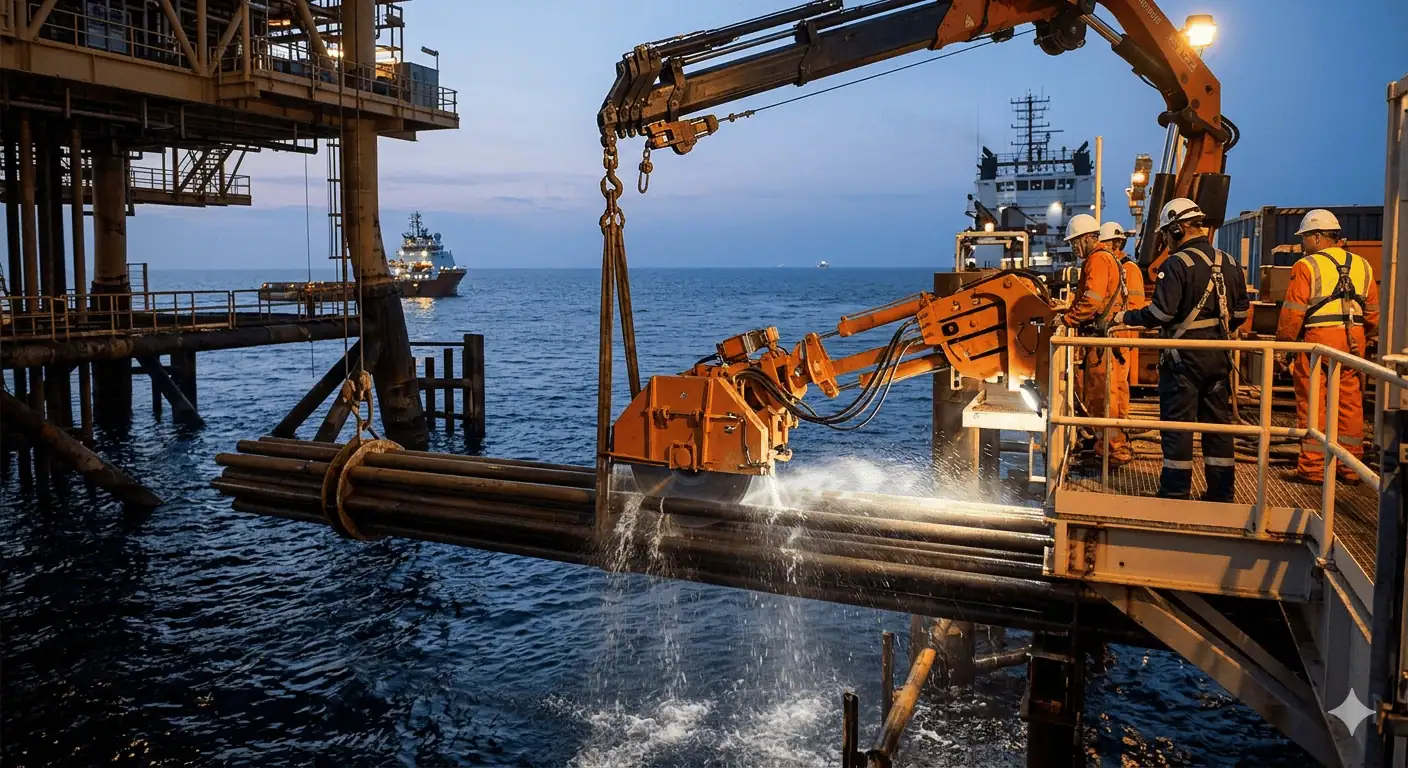
Pipeline removal in Indonesian waters typically uses reverse S-lay or reel-lay methods, where the pipeline is cut into manageable sections and recovered onto a vessel. For smaller diameter pipelines, a single lift may be possible. For larger diameter pipelines, the pipeline must be cut into 12-meter sections using diamond wire saws or abrasive water jet cutters deployed from a diving support vessel or ROV.
3. Partial Removal with Burial
This hybrid approach involves removing the exposed sections of pipeline (such as span sections and risers) and burying the remaining pipeline in a prepared trench. This method is commonly used in Indonesian shallow waters where complete removal is costly but navigation safety must be ensured.
Environmental Assessment and Monitoring
Environmental considerations are central to subsea pipeline decommissioning in Indonesia. The AMDAL (Analisis Mengenai Dampak Lingkungan) process requires a thorough assessment of potential environmental impacts and a mitigation plan.
Pre-Decommissioning Environmental Survey
Before any decommissioning activity begins, a comprehensive environmental baseline survey must be conducted. This survey includes:
- Seabed sediment sampling: To determine existing contamination levels and establish a baseline for post-decommissioning comparison.
- Benthic fauna assessment: To document the marine ecosystem that may be affected by decommissioning activities.
- Water quality testing: To measure turbidity, hydrocarbon content, and heavy metal concentrations.
- Side-scan sonar survey: To map the pipeline route, identify free spans, and detect any existing damage or scour.
Post-Decommissioning Monitoring
SKK Migas typically requires post-decommissioning monitoring for 3-5 years after completion. Monitoring activities include seabed surveys to confirm pipeline stability (for leave-in-place), environmental sampling to verify no residual contamination, and navigation hazard inspections.
Equipment and Techniques for Pipeline Decommissioning
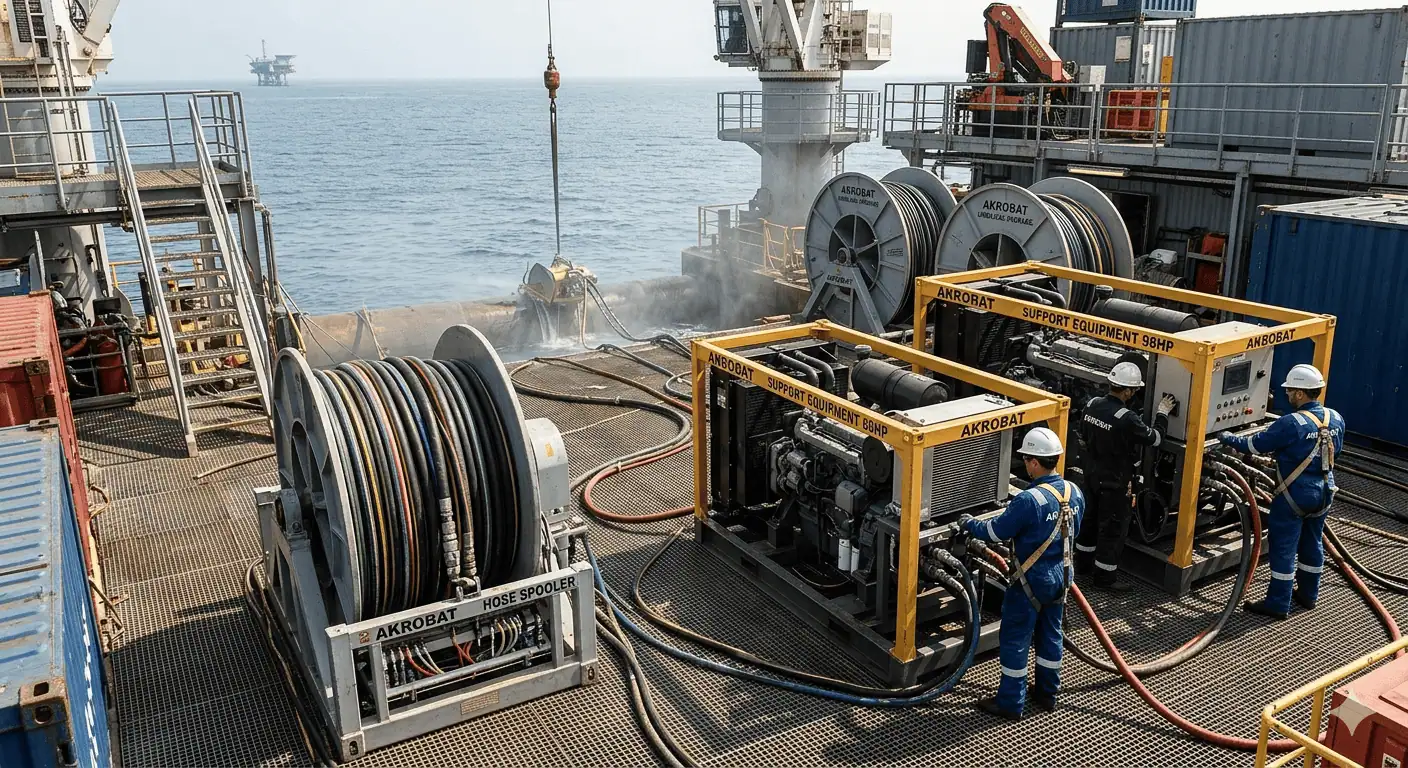
Subsea pipeline decommissioning requires specialized equipment that must be mobilized to the offshore site. The equipment selection depends on water depth, pipeline diameter, decommissioning method, and seabed conditions.
Pipeline Cleaning and Flushing
Before a pipeline can be decommissioned, it must be cleaned of residual hydrocarbons. This is typically done using a sequence of pigging operations:
- Cleaning pigs: Mechanical pigs that remove wax, scale, and debris from the pipe wall.
- Gel pigs: Gel-based pigs that absorb and transport residual hydrocarbons.
- Verification pigs: Gauge pigs that confirm the pipeline is clean to the required standard.
The effluent from the cleaning process must be captured and treated to meet Indonesian environmental discharge standards (Kepmen LH No. 19 Tahun 2010 for offshore oil and gas).
Pipeline Cutting Equipment
For pipeline removal, cutting is performed using one of the following methods:
- Diamond wire saw: The most common method for cutting steel pipelines. A diamond-impregnated wire is looped around the pipeline and driven at high speed to cut through the steel wall. Diamond wire saws can cut pipelines up to 48 inches in diameter.
- Abrasive water jet cutter: Uses a high-pressure water jet mixed with abrasive particles to cut through steel. Suitable for pipelines with concrete weight coating where diamond wire may be less effective.
- Explosive cutting: Used for severance at mudline level, particularly for conductor and pile cutting. Requires special permits and is less commonly used for pipelines in Indonesia due to environmental concerns.
- Hydraulic shear: A mechanical cutter that uses hydraulic force to sever the pipeline. Suitable for smaller diameter pipelines (up to 24 inches).
Vessel Requirements
Decommissioning operations in Indonesia typically require:
- Diving Support Vessel (DSV): For shallow water operations (up to 50m depth) where diver intervention is needed.
- ROV Support Vessel: For deepwater operations where ROV-deployed tools are used.
- Construction Vessel: For pipeline recovery operations, equipped with crane, A&R winch, and deck space for recovered pipeline sections.
- Supply Vessels: For transporting equipment, fuel, and waste to and from the offshore site.
Planning a Subsea Pipeline Decommissioning Project in Indonesia
Successful decommissioning requires meticulous planning. The following steps outline the typical project planning process for subsea pipeline decommissioning in Indonesia.
Step 1: Pipeline Inventory and Condition Assessment
Document all pipelines to be decommissioned, including diameter, wall thickness, length, coating type, burial status, and current condition. Conduct an underwater inspection to identify free spans, damage, and seabed conditions along the route.
Step 2: Regulatory Engagement
Engage with SKK Migas early in the planning process. Submit a Concept of Decommissioning for preliminary feedback before developing the full Plan of Decommissioning. This early engagement can identify potential regulatory issues before significant resources are committed.
Step 3: Method Selection and Engineering
Based on the pipeline condition, environmental assessment, and regulatory requirements, select the decommissioning method. Perform engineering analysis to confirm the feasibility of the selected method, including pipeline stress analysis for recovery operations and stability analysis for leave-in-place options.
Step 4: Environmental Permitting
Prepare and submit the AMDAL document to KLHK. The AMDAL process typically takes 6-12 months, so it should be initiated early in the project timeline.
Step 5: Contractor Selection and Equipment Mobilization
Select contractors with experience in Indonesian offshore decommissioning. Key qualifications to verify include previous SKK Migas-approved projects, appropriate vessel fleet, and proven capability with the selected cutting and recovery methods.
Step 6: Execution and Post-Decommissioning
Execute the decommissioning plan according to the approved schedule. Conduct post-decommissioning surveys and submit completion reports to SKK Migas and KLHK. Maintain monitoring activities as required by the approved plan.
Sourcing Decommissioning Services in Indonesia
When sourcing subsea pipeline decommissioning services in Indonesia, consider the following factors to ensure a safe, compliant, and cost-effective project.
Local Content Requirements
SKK Migas imposes local content requirements (TKDN) on decommissioning projects. Operators must demonstrate efforts to use Indonesian-flagged vessels, Indonesian-registered companies for logistics and support, and Indonesian workers where qualified. Understanding these requirements early helps avoid delays in project approval.
Contractor Experience
Verify that the contractor has:
- Previous experience with subsea pipeline decommissioning in Indonesian waters
- Approved decommissioning plans with SKK Migas
- Appropriate vessel availability and mobilization capability
- Subsea cutting equipment suitable for the pipeline specifications
- Environmental monitoring and survey capabilities
Cost Considerations
The cost of subsea pipeline decommissioning in Indonesia varies widely based on water depth, pipeline length, decommissioning method, and vessel requirements. Typical cost ranges:
- Leave-in-place: $50-$150 per meter (cleaning, capping, monitoring)
- Partial removal: $200-$500 per meter (cutting, recovery of exposed sections)
- Complete removal: $500-$1,500 per meter (cutting, recovery, disposal)
These costs exclude vessel mobilization, environmental surveys, regulatory permitting, and post-decommissioning monitoring, which can add $2-10 million depending on project scope.
For projects requiring specialized equipment such as diamond wire saws, ROV-deployed tools, or offshore equipment rental, working with an experienced local partner ensures regulatory compliance and operational efficiency.
Frequently Asked Questions About Subsea Pipeline Decommissioning Indonesia
How long does subsea pipeline decommissioning take in Indonesia?
The timeline varies by project scope. Planning, permitting, and engineering typically take 12-24 months. Offshore execution for a 10-kilometer pipeline takes 2-6 weeks depending on method and weather. Post-decommissioning monitoring extends 3-5 years.
Can a pipeline be left on the seabed in Indonesia?
Yes, leave-in-place is permitted by SKK Migas when the pipeline does not pose a navigation or environmental hazard. The pipeline must be cleaned, capped, and monitored. Approval requires a demonstration that removal is not technically or economically justified.
What environmental permits are required?
An AMDAL (environmental impact assessment) approved by KLHK is required for all subsea pipeline decommissioning projects in Indonesia. Additional permits may be required from local maritime authorities depending on the project location.
How are decommissioning costs handled in production sharing contracts?
Decommissioning costs are typically recoverable under Production Sharing Contract (PSC) terms, subject to SKK Migas approval. Operators must establish a decommissioning fund during the production phase to ensure funds are available when decommissioning occurs.
What happens to recovered pipeline materials?
Recovered steel pipelines are typically transported to onshore facilities for cleaning, cutting, and recycling. Concrete weight coatings are crushed and may be used as construction aggregate. All waste disposal must comply with Indonesian hazardous waste regulations (B3 waste).
Is explosive cutting allowed in Indonesian waters?
Explosive cutting is permitted but requires special permits from multiple agencies including SKK Migas, KLHK, and the Indonesian Navy. It is typically restricted to conductor and pile severance at mudline level and requires extensive environmental mitigation measures.