Retiring an offshore platform in Indonesia is one of the most complex, high-stakes projects an operator will ever undertake. The regulatory requirements are demanding, the technical scope is broad, the environmental obligations are significant, and the consequences of getting it wrong — in terms of safety incidents, regulatory penalties, or unresolved site clearance — can follow an operator for decades. At the center of every successful decommissioning program is the right platform decommissioning contractor Indonesia. Choosing the right partner is not merely a procurement decision — it is a strategic commitment that will shape the project’s outcome from engineering through to final site clearance certificate.
This guide provides a comprehensive framework for evaluating and selecting a platform decommissioning contractor Indonesia: the scope of work they must execute, the regulatory requirements they must meet, and the selection criteria that distinguish the best from the rest.
The Scope of a Platform Decommissioning Contractor in Indonesia
A platform decommissioning contractor in Indonesia typically manages and executes a broad scope of work that may span several years from initial engineering through final regulatory closeout:
Project Engineering and Management
The contractor’s engineering team develops the decommissioning plan, defines the removal sequence, designs the lift and cutting operations, sizes the required vessels, and prepares all regulatory submission documents. For Indonesian projects, this includes the Decommissioning Program submission to SKK Migas and the environmental impact assessment (AMDAL or UKL-UPL) required by KLHK.
Well Plugging and Abandonment (P&A)
All wells associated with the platform must be permanently plugged and abandoned before structural removal can begin. The decommissioning contractor coordinates P&A operations with specialist well intervention contractors. P&A is governed by SKK Migas and MIGAS well integrity requirements and must be fully completed and documented before topside removal activities commence.
Topsides Preparation and Removal
Topsides preparation involves flushing and cleaning all process systems, removing hazardous materials (asbestos, NORM — naturally occurring radioactive material, lead paint, mercury instruments), draining all fluids, and preparing the structure for lift. A complete as-built weight survey is conducted to confirm lift weight for heavy lift vessel planning.
Topsides removal is executed by heavy lift vessel (semi-submersible crane vessel or derrick lay barge). The contractor manages the complex interface between the offshore structural team, the lifting master, and the vessel owner.
Jacket and Substructure Removal
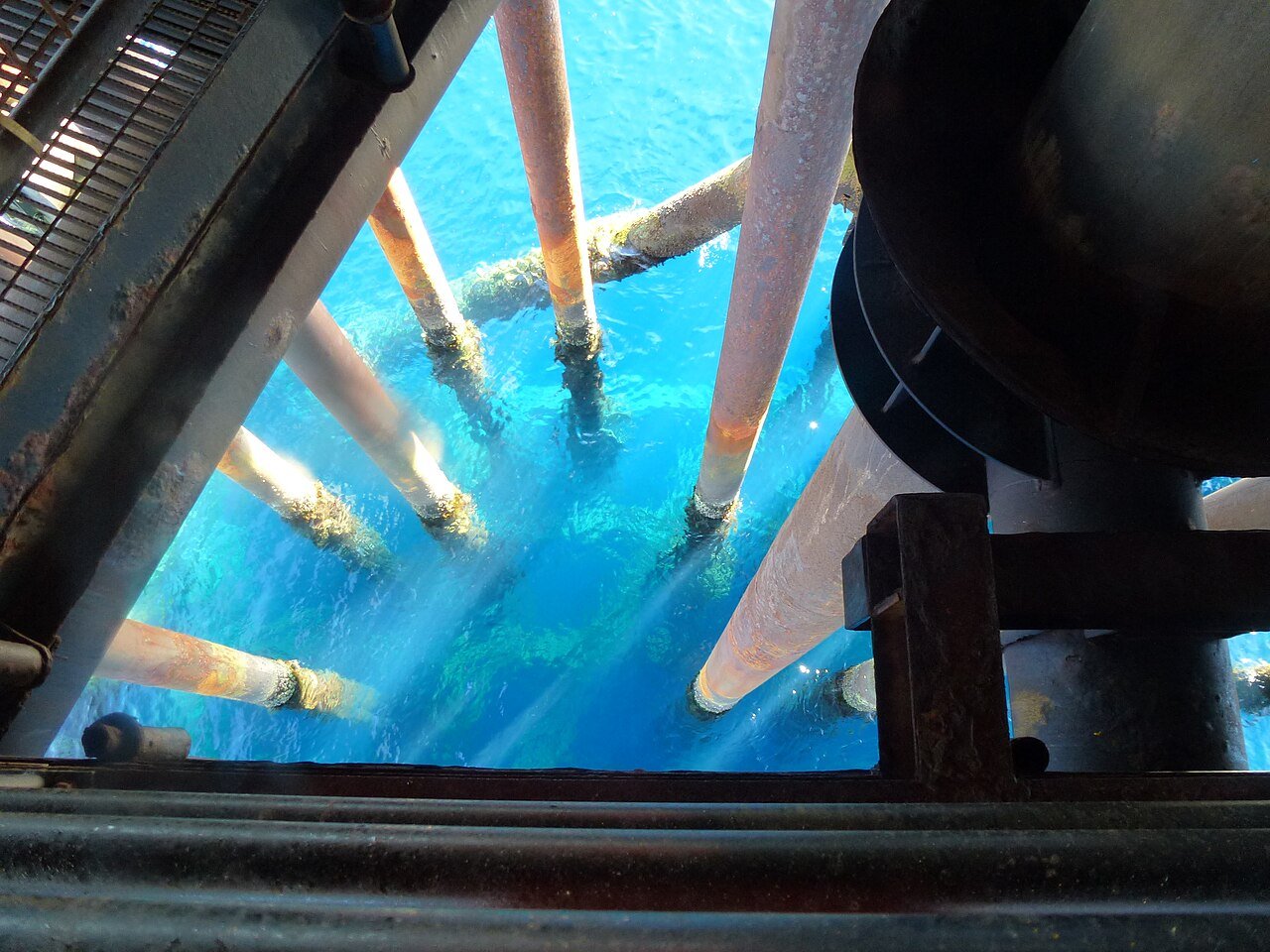
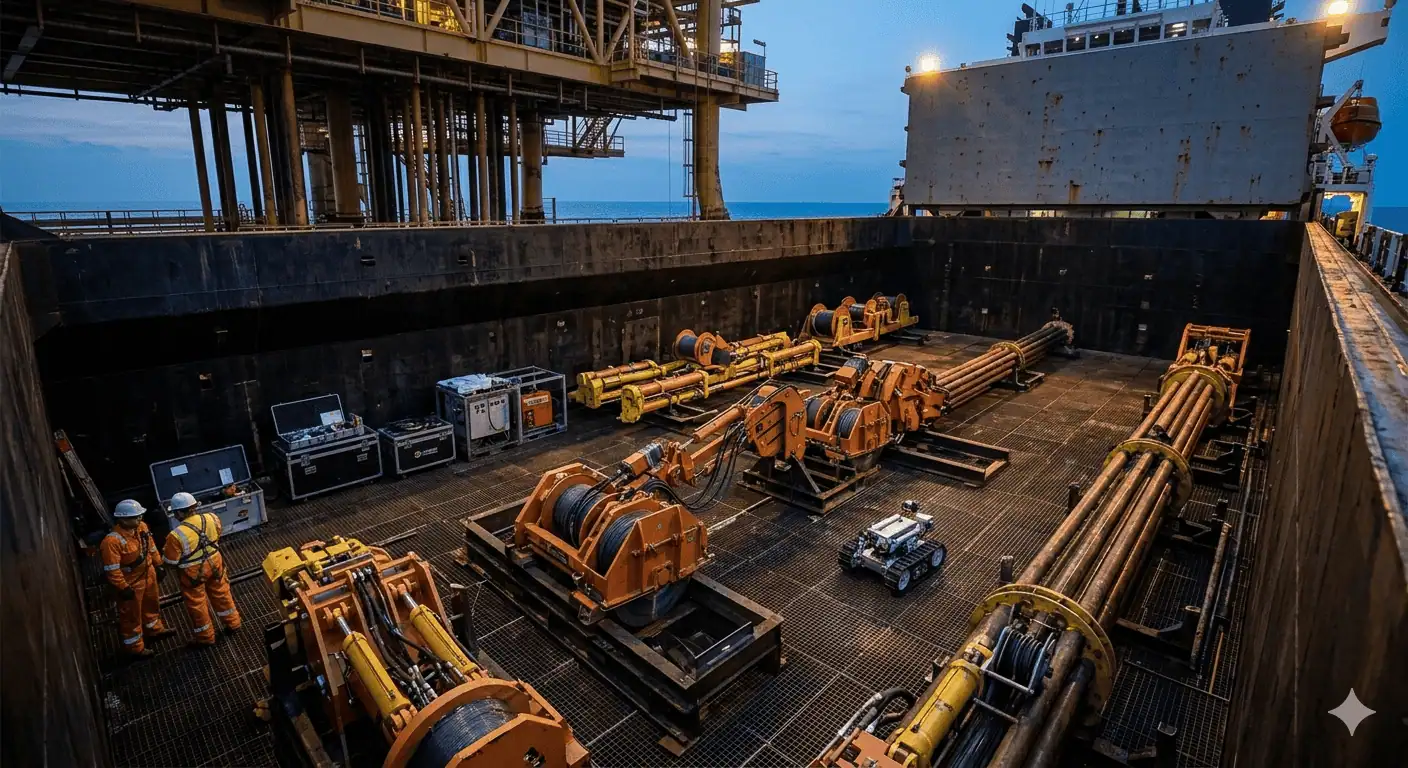
The jacket must be severed at defined elevations and lifted from the seabed. Cutting operations use diamond wire saws, cold cutting machines, or other certified cutting methods. See our detailed technical guides on diamond wire saw technology for offshore decommissioning in Indonesia and cutting services for context on the technical complexity involved.
Conductor and Pile Removal
Conductors and foundation piles are severed at or below mudline using subsea cutting tools (dual pin drills, diamond wire saws, or clamshell cutters). The contractor manages diver or ROV operations required to deploy these tools and recover the severed sections. Learn more about on-site machining and cutting services for O&G facilities.
Site Clearance and Environmental Restoration
Following structure removal, the seabed is surveyed by an independent marine surveyor using multibeam sonar and sub-bottom profiler. All debris must be located and removed. A post-clearance survey report is submitted to SKK Migas and KLHK to formally document compliance with seabed clearance requirements.

SKK Migas and Regulatory Requirements for Platform Decommissioning Contractors in Indonesia
Operating as a platform decommissioning contractor in Indonesia requires compliance with a specific regulatory framework:
SKK Migas PTK Guidelines
SKK Migas Pedoman Tata Kerja (PTK) guidelines govern all aspects of upstream oil and gas operations in Indonesia, including decommissioning. The relevant PTK requires operators to submit a comprehensive Decommissioning Program to SKK Migas for review and approval before commencing work. Contractors working under KKKS contracts must comply with the specific PTK requirements invoked in their contract scope.
MIGAS Technical Standards
The Directorate General of Oil and Gas (MIGAS) sets technical standards for offshore equipment, lifting operations, and diving activities applicable to decommissioning work in Indonesian waters. All major lifting equipment must carry valid Indonesian maritime or MIGAS inspection certificates.
KLHK Environmental Requirements
Indonesia’s Ministry of Environment and Forestry (KLHK) oversees environmental aspects of decommissioning. Contractors must hold appropriate environmental permits (SPPL, UKL-UPL, or AMDAL depending on project scale) and comply with waste management regulations covering NORM, PCB-containing equipment, and contaminated materials removed from the platform.
TKDN (Local Content) Requirements
Indonesian local content regulations (Peraturan Menteri ESDM and SKK Migas TKDN guidelines) require a minimum percentage of Indonesian-sourced goods and services in upstream O&G procurement. Decommissioning contractors must demonstrate TKDN compliance in their bid proposals and report TKDN achievement throughout the project.
Key Selection Criteria for Platform Decommissioning Contractors in Indonesia
When evaluating candidates for a platform decommissioning contractor Indonesia selection, apply these criteria systematically:
1. Track Record on Comparable Projects
The single most important indicator of future performance is past performance on comparable projects. Has the contractor successfully completed decommissioning of platforms in similar water depths, structural complexity, and geographic locations? References from Indonesian or regional operators carry more weight than North Sea or Gulf of Mexico track records due to the specific regulatory, logistical, and environmental context.
2. Equipment Ownership and Access
Does the contractor own the cutting, lifting, and intervention equipment required for your scope, or must they subcontract everything? A contractor with its own certified diamond wire saw systems, subsea intervention tools, and established relationships with heavy lift vessel owners can move faster, control costs better, and manage technical interfaces more effectively than a pure management contractor that relies entirely on subcontractors.
3. HSE Performance
Request the contractor’s Total Recordable Incident Rate (TRIR) for the past three years on comparable offshore projects. Verify their HSE management system is certified (ISO 45001 or equivalent) and compatible with your KKKS safety requirements. Ask specifically about their experience managing diving and ROV operations — the highest-risk activities in most Indonesian decommissioning projects.
4. Financial Standing
Decommissioning projects are multi-year programs with significant upfront mobilization costs. The contractor must be financially stable enough to sustain operations through the project lifecycle without financial distress that could interrupt the work. Request audited financial statements and bank reference letters as part of the pre-qualification process.
5. Regulatory Knowledge
The contractor must have demonstrated experience navigating Indonesia’s specific regulatory framework: SKK Migas PTK submissions, KLHK environmental permitting, MIGAS equipment certification, and TKDN reporting. International contractors without prior Indonesian experience often underestimate the time and complexity of Indonesian regulatory processes, leading to project delays.
The Decommissioning Contractor Selection Process in Indonesia
Most Indonesian operators use a structured two-stage selection process for major decommissioning projects:
Stage 1: Pre-Qualification (PQ)
Interested contractors submit a Pre-Qualification questionnaire covering company profile, financial standing, track record, HSE performance, equipment ownership, key personnel CVs, and TKDN capability. The operator’s evaluation team scores each submission and shortlists 3-5 candidates for the tender stage.
Stage 2: Invitation to Tender (ITT)
Shortlisted contractors receive a detailed Invitation to Tender including the scope of work, technical specifications, draft contract terms, and commercial pricing format. Technical proposals are evaluated separately from commercial proposals to ensure the best technical approach is identified before commercial optimization.
Lump Sum vs. Reimbursable Contract
The choice of contract type significantly affects risk allocation. Lump sum contracts transfer more cost risk to the contractor but require a fully defined scope. Reimbursable (cost-plus) contracts are more common for complex, scope-uncertain decommissioning projects where it is difficult to define all quantities in advance. Many Indonesian decommissioning contracts use a hybrid approach: lump sum for well-defined scope elements, reimbursable for scope items with higher uncertainty.

Get Expert Consultation
Our team provides platform decommissioning contracting services across Indonesian offshore waters.
Frequently Asked Questions About Platform Decommissioning Contractor Indonesia
What does a platform decommissioning contractor do?
Manages the complete platform retirement: engineering, P&A coordination, topsides removal, jacket dismantlement, conductor removal, waste management, seabed clearance, and regulatory reporting to SKK Migas and KLHK.
How are decommissioning contractors selected in Indonesia?
Via competitive tender managed by the KKKS, evaluating technical capability, HSE performance, financial standing, SKK Migas pre-qualification status, TKDN compliance, and commercial competitiveness.
What SKK Migas requirements must contractors meet?
Registration and pre-qualification under the KKKS vendor management system, compliance with relevant PTK guidelines, and coordination with KLHK for environmental permits and waste management approvals.
What is the difference between a main contractor and a service provider?
A main contractor holds the primary operator contract and manages overall scope, safety, and schedule. Service providers supply specialist capabilities (cutting, heavy lift, P&A, surveying) under the main contractor’s management.
How much does platform decommissioning cost in Indonesia?
From USD 5-20 million for small shallow-water Java Sea platforms to USD 50-200+ million for larger, more complex assets. FEED-phase engineering estimates define project-specific costs based on scope, vessel requirements, and waste disposal needs.