Falls from height remain one of the leading causes of workplace fatalities in Indonesia’s oil, gas, and industrial sectors. Working at elevation on offshore platform decks, refinery structures, LNG plant columns, and industrial facilities is an unavoidable part of operations and maintenance — but doing so without proper fall protection is a preventable risk that no responsible operator should accept. The lifeline fall arrest system is the engineering control that makes work at height safe, allowing workers to move freely and work productively while remaining continuously protected against the consequences of a fall.
This guide provides a comprehensive overview of lifeline fall arrest systems in Indonesia: the types available, the standards they must meet, where they are used in Indonesian oil and gas and industrial operations, and what to look for when sourcing fall protection equipment.
Understanding Fall Protection: The Hierarchy of Controls
Before specifying a lifeline fall arrest system, it is important to understand where fall arrest sits in the hierarchy of fall protection controls. The appropriate control must be selected based on the nature of the work and the feasibility of higher-order controls:
- Elimination: Design the work so no one needs to work at height. The most effective control but often not feasible in operational settings.
- Passive fall prevention: Guard rails, barriers, safety nets, and covers that prevent falls without worker action. Should be used wherever possible as the primary control.
- Fall restraint: Personal system that prevents the worker from reaching a fall hazard (short lanyard to nearby anchor). Preferred over fall arrest where it is feasible to keep workers away from the edge.
- Fall arrest: Personal system (lifeline, harness, lanyard) that allows the worker to reach the edge but arrests a fall if it occurs. Required where the work requires edge access.
- Administrative controls: Procedures, permits, supervision, and training to manage residual risk after engineering controls are applied.
Lifeline fall arrest systems are fourth in this hierarchy — they are the last line of defense against fall injury and should always be supplemented by higher-order controls where practical.
Types of Lifeline Fall Arrest Systems for Industrial and Offshore Use in Indonesia
The lifeline fall arrest system market offers several configurations suited to different work environments in Indonesian O&G and industrial facilities:
1. Horizontal Lifeline Systems
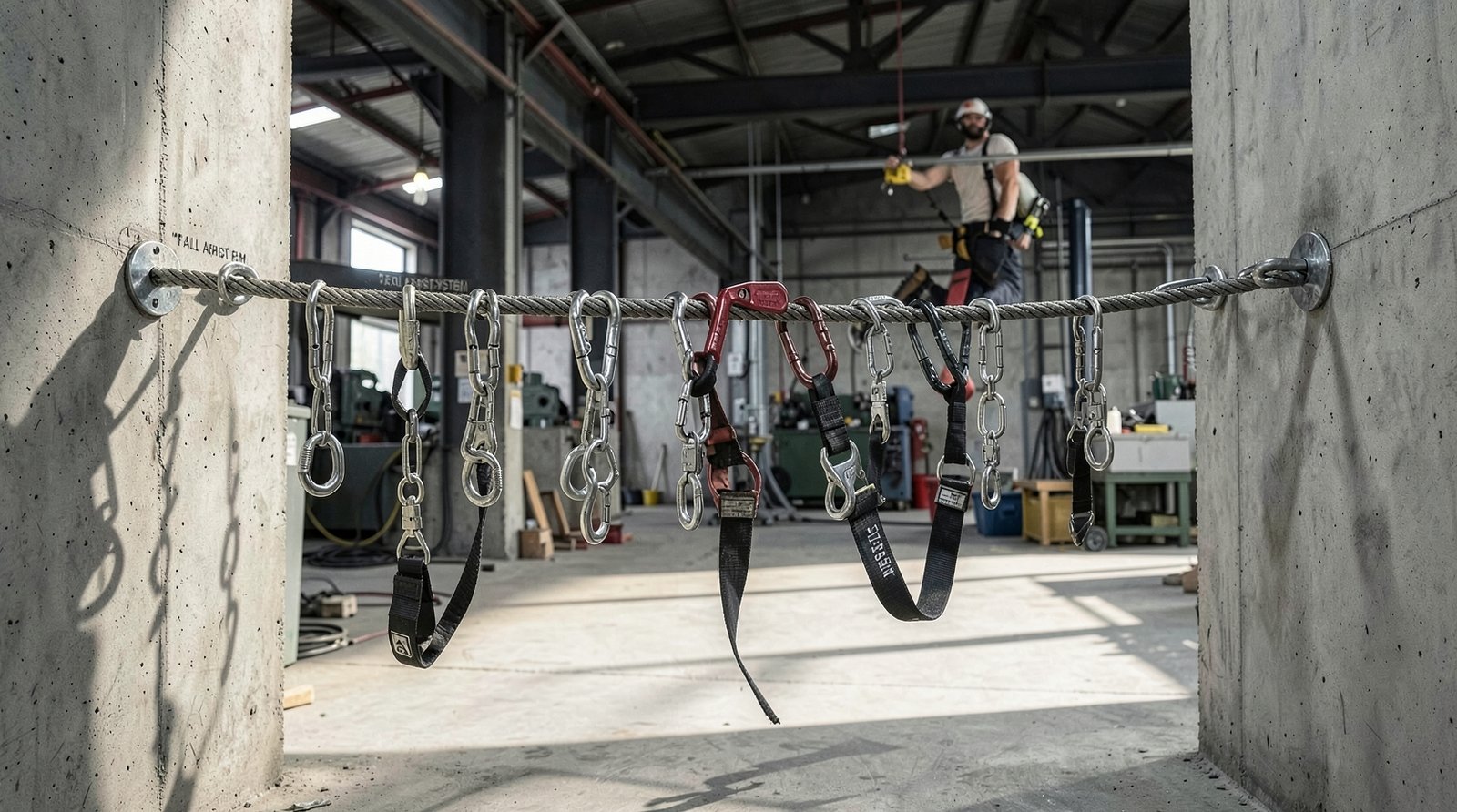
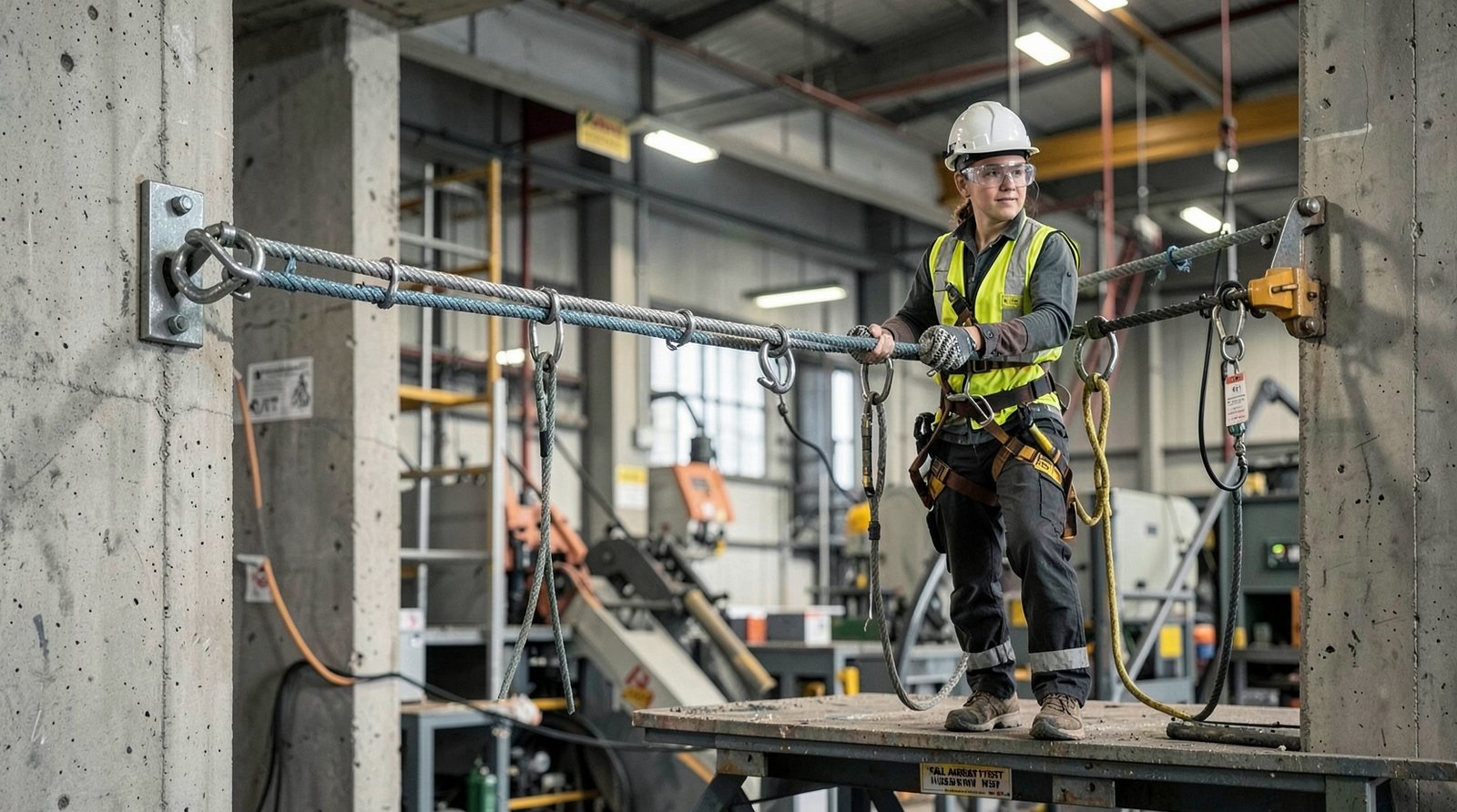
A horizontal lifeline system consists of a steel wire rope or synthetic rope strung between two or more anchor points at approximately worker shoulder height. The worker clips their connecting lanyard to a traveler (sliding attachment) on the lifeline, which moves freely along the line as the worker travels. This allows continuous fall protection across the full length of the lifeline without disconnecting.
Horizontal lifelines are the standard fall protection system for deck edge work on offshore platforms, scaffold runs, walkways above process equipment, and work on sloped roofs at refineries and LNG plants. They are installed either as permanent systems (galvanized or stainless steel wire with engineered anchor posts) or temporary systems (for turnaround and project work).
2. Vertical Lifeline Systems
Vertical lifelines are used for fall protection during climbing and vertical movement tasks: ladder access to elevated platforms, climbing fixed vertical structures, work in confined spaces with vertical entry, and rescue from elevated locations. A rope or cable is anchored at the top, and a rope grab or self-retracting device attached to the worker’s harness slides up the line as the worker climbs and locks instantly in the event of a fall.
3. Self-Retracting Lanyards (SRL)
A Self-Retracting Lanyard (SRL) is a compact fall arrest device that automatically extends and retracts a wire rope or webbing as the worker moves. In the event of a fall, a braking mechanism activates and arrests the fall within 0.3-0.6 meters — far shorter than the fall distance with a standard 1.8m energy-absorbing lanyard. SRLs are the preferred fall arrest tool for work on offshore platform decks and in elevated work positions where short fall clearance is limited.
4. Overhead Trolley and Rail Systems
Overhead rail systems consist of a rigid or semi-rigid beam or monorail mounted above the work area, with a trolley that rolls along the rail and provides an overhead anchor for the worker’s lanyard or SRL. This configuration is used in vessel interiors, tank entries, under-structure maintenance, and other locations where a low-level lifeline would obstruct work. Overhead systems provide 360-degree coverage of the work area from a single anchor system.
Standards for Lifeline Fall Arrest Systems in Indonesia
All lifeline fall arrest systems used on Indonesian oil and gas facilities and industrial sites must comply with applicable national and international standards:
Indonesian Regulatory Requirements
- UU No. 1/1970: Indonesia’s Occupational Safety Law mandates that employers provide safe working conditions, including fall protection for work at height.
- Permenaker No. 9/2016: Ministerial Regulation on Working at Height defines the specific requirements for fall protection systems, harness certification, operator training, and rescue planning for work at height above 1.8 meters in Indonesian workplaces.
- SNI standards: Relevant SNI standards for personal protective equipment and fall protection equipment apply to equipment used in Indonesian workplaces.
International Standards Widely Applied in Indonesia
- EN 795: European standard for anchor devices for personal fall protection equipment. Class A (structural anchors), Class B (portable horizontal lifeline anchors), and Class C (horizontal flexible lifelines) cover the main lifeline system components.
- EN 353-1 and EN 353-2: Guided type fall arresters on rigid and flexible anchor lines (vertical lifeline systems).
- EN 360: Retractable type fall arresters (SRLs).
- ANSI Z359 series: American standards for fall protection, widely used in Indonesian O&G operations by operators with US parent companies.
For comprehensive guidance on fall protection standards, refer to the publications of the DNV and API for offshore applications, and to Indonesia’s Ministry of Manpower (Kemnaker) for domestic regulatory requirements.
Applications of Lifeline Fall Arrest Systems in Indonesian Oil and Gas
Lifeline fall arrest systems in Indonesia are deployed across all segments of the O&G and industrial sectors where work at height is performed:
Offshore Platforms
Offshore platforms are perhaps the most demanding environment for fall protection in Indonesia. Workers are exposed to fall risks from all sides — over the side of the deck, through open gratings, from equipment structures, and from elevated scaffolding. Permanent horizontal lifeline systems are installed on deck edges, gangways, and crane pads. Temporary lifeline systems are installed for turnaround, modification, and decommissioning activities. For broader safety considerations in offshore operations, see our guide on offshore decommissioning services in Indonesia.
Refineries and Petrochemical Plants
Pertamina refineries and the petrochemical plants at Cilegon and East Kalimantan involve extensive elevated structures — distillation columns, heat exchanger banks, pipe racks, and flare stacks — where maintenance workers must access at significant height. Horizontal lifeline systems on walkways and fixed ladder vertical lifelines are standard permanent infrastructure at these facilities.
LNG Plants and Storage Tanks
LNG storage tanks and the elevated structures of Bontang LNG and Tangguh LNG require fall protection systems rated for cryogenic temperature environments. Stainless steel wire rope and low-temperature rated hardware are specified for lifeline systems in cryogenic service areas. Learn more about safety in related on-site operations from our guide on on-site machining solutions for O&G facilities in Indonesia.
Construction and Fabrication Yards
Indonesia’s shipbuilding and module fabrication yards in Batam, Karimun, and Cilegon involve extensive work at height during hull construction, module assembly, and equipment installation. Overhead crane girder access, scaffold on vessel exteriors, and elevated module assembly all require comprehensive lifeline fall arrest protection.

Selecting Lifeline Fall Arrest Systems for Indonesian Projects
When specifying or procuring lifeline fall arrest systems in Indonesia, evaluate these key factors:
Load Calculation and System Engineering
Horizontal lifeline systems must be professionally engineered to withstand the dynamic loads generated by a fall arrest event. The anchor posts and intermediate supports must be designed for the maximum expected arrest force, which depends on the worker’s weight, the lanyard type, and the sag angle of the lifeline under load. This is not a DIY installation — always use a qualified fall protection system designer and installer.
Material Selection for Tropical and Offshore Environments
Indonesia’s salt atmosphere, high humidity, and tropical UV exposure accelerate corrosion of fall protection hardware. Specify stainless steel wire rope (grade 316L for offshore), hot-dip galvanized anchor posts for non-stainless applications, and UV-stabilized webbing for harnesses. Avoid carbon steel hardware in offshore or coastal environments without adequate corrosion protection.
Certification and Test Documentation
All lifeline system components must carry valid third-party certification (CE marking for EN-standard products, or equivalent). Request the Declaration of Conformity and test reports for each component. Annual inspection and re-certification of installed lifeline systems is required under Permenaker 9/2016.
Training and Rescue Planning
Equipment alone is not sufficient. Workers using fall arrest systems must be trained in harness fitting, lanyard connection, pre-use inspection, and the specific system installed at their work location. A documented rescue plan must also be in place — a worker suspended in a harness after a fall arrest can suffer suspension trauma within minutes if not rescued promptly.
Get Expert Consultation
Our team provides lifeline fall arrest systems and height safety equipment for industrial and offshore sites across Indonesia.
Frequently Asked Questions About Lifeline Fall Arrest System Indonesia
What is a lifeline fall arrest system?
A personal fall protection system (anchor, lifeline, connector, and harness) that allows workers to move along a work area while remaining continuously protected. If a fall occurs, the system arrests it within a short distance and controlled force.
What are the main types?
Horizontal lifeline (for movement along a work area), vertical lifeline (for climbing), self-retracting lanyards (compact arrest within 0.3-0.6m), and overhead trolley/rail systems (360-degree coverage).
What standards govern them in Indonesia?
UU No. 1/1970, Permenaker No. 9/2016, relevant SNI standards, and international standards (EN 795, EN 360, ANSI Z359) widely applied in Indonesian O&G operations.
Where are they used on offshore platforms?
Deck edges, gangways, crane pads, scaffold, derrick access, lifeboat areas, and during all work at height above 1.8m on Indonesian offshore installations.
What is the difference between fall arrest and fall restraint?
Fall restraint prevents the worker from reaching the hazard (short lanyard). Fall arrest allows edge access but arrests a fall if it occurs. Fall restraint is preferred where it is feasible to keep workers away from the edge.